Cords (Art. 400)

Set where and how the cord is used, the circuit, the load and the ambient. The app gives the cord to order with its size and conductor count, every other type that also meets the conditions, and the working, and writes it as a PDF.

The tools - now showing Cords (Art. 400)
A

One job, start to finish — slides

The app’s own example, every screen in order, 20 steps.
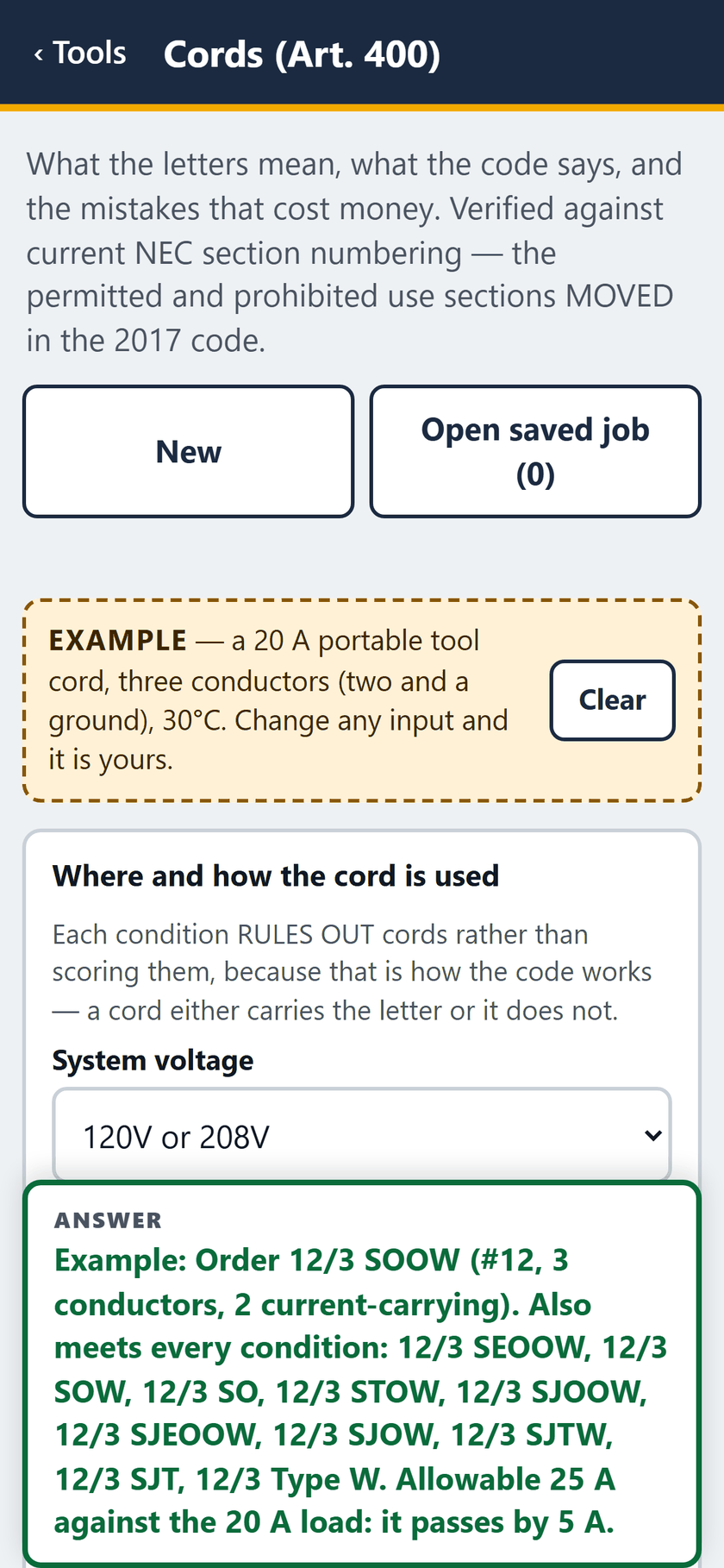
  1. Cords (Art. 400) screen: The example opens filled in: a 20 A portable tool cord, with the answer pinned at the foot: order 12/3 SOOW.
    STEP 1 OF 20The example opens filled in: a 20 A portable tool cord, with the answer pinned at the foot: order 12/3 SOOW.

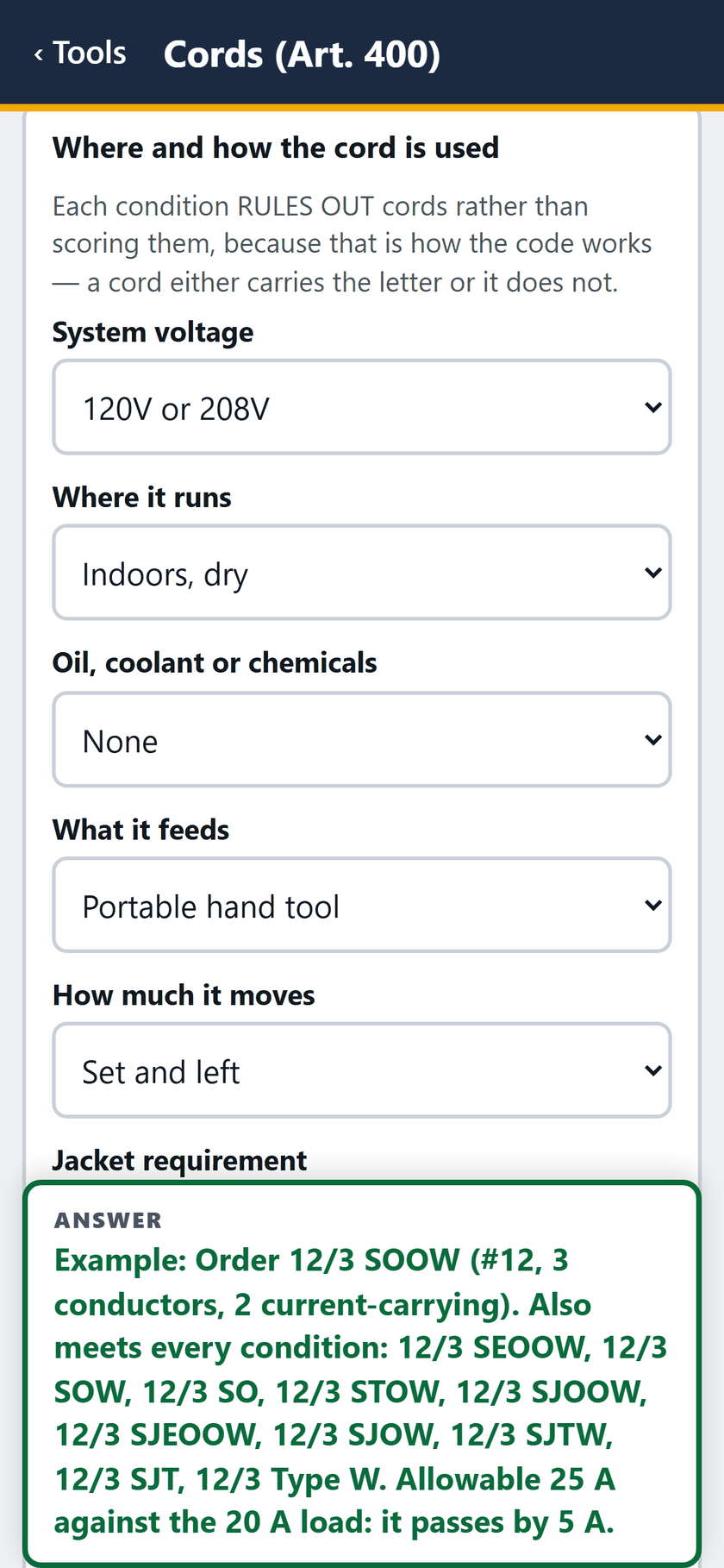
  2. Cords (Art. 400) screen: Where and how the cord is used: 120V or 208V, indoors and dry, no oil, a portable hand tool, set and left.
    STEP 2 OF 20Where and how the cord is used: 120V or 208V, indoors and dry, no oil, a portable hand tool, set and left.

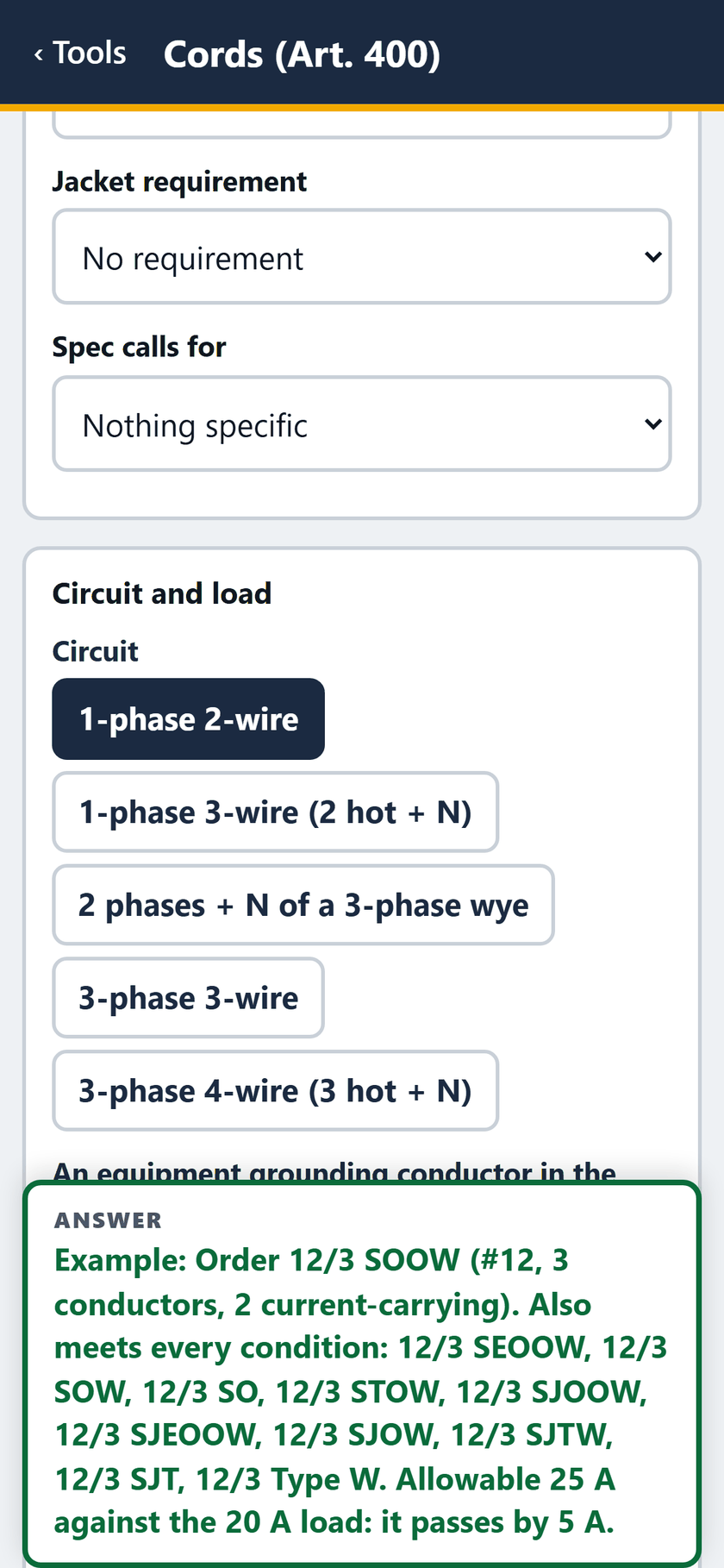
  3. Cords (Art. 400) screen: No jacket requirement, nothing specific in the spec. Circuit and load: 1-phase 2-wire.

    STEP 3 OF 20No jacket requirement, nothing specific in the spec. Circuit and load: 1-phase 2-wire.
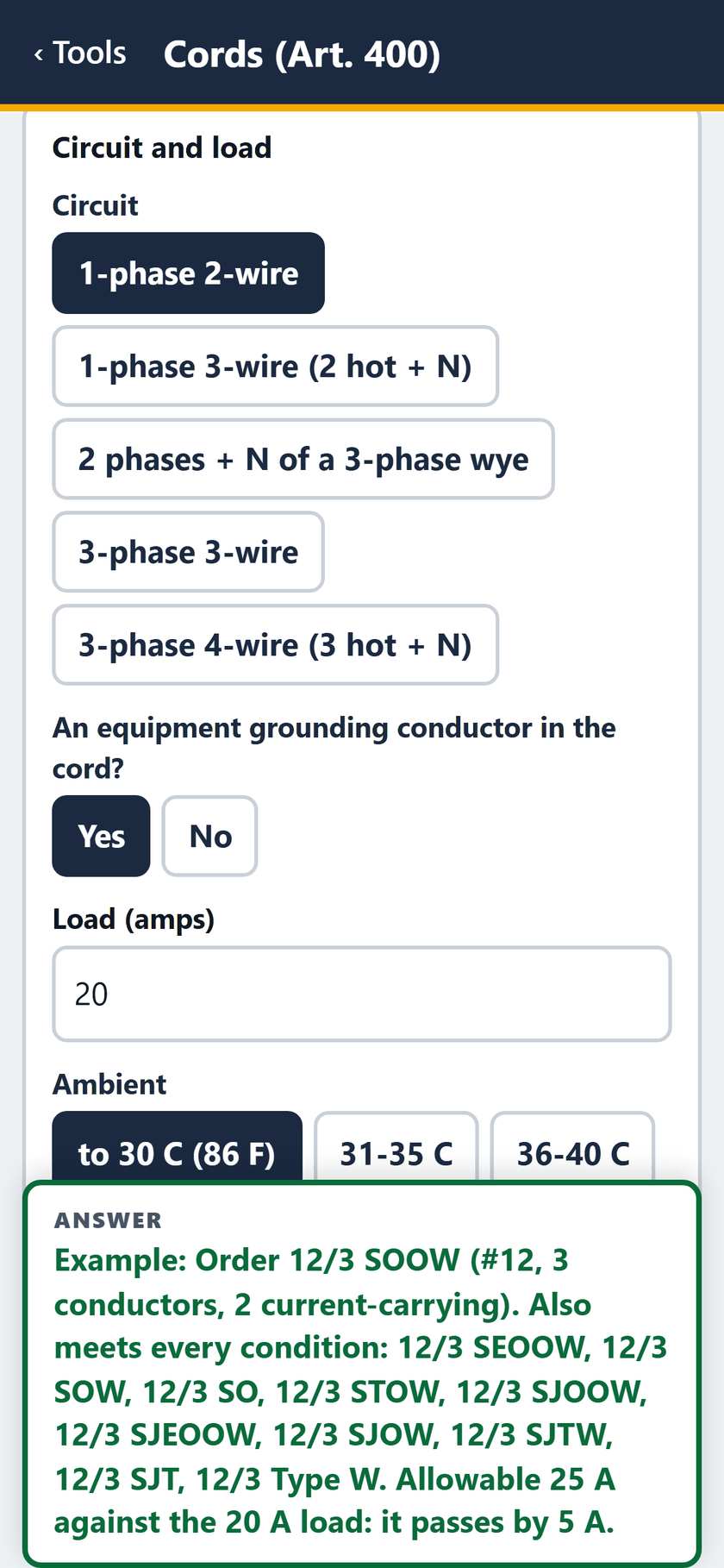
  4. Cords (Art. 400) screen: An equipment grounding conductor in the cord: yes. Load: 20 amps.
    STEP 4 OF 20An equipment grounding conductor in the cord: yes. Load: 20 amps.

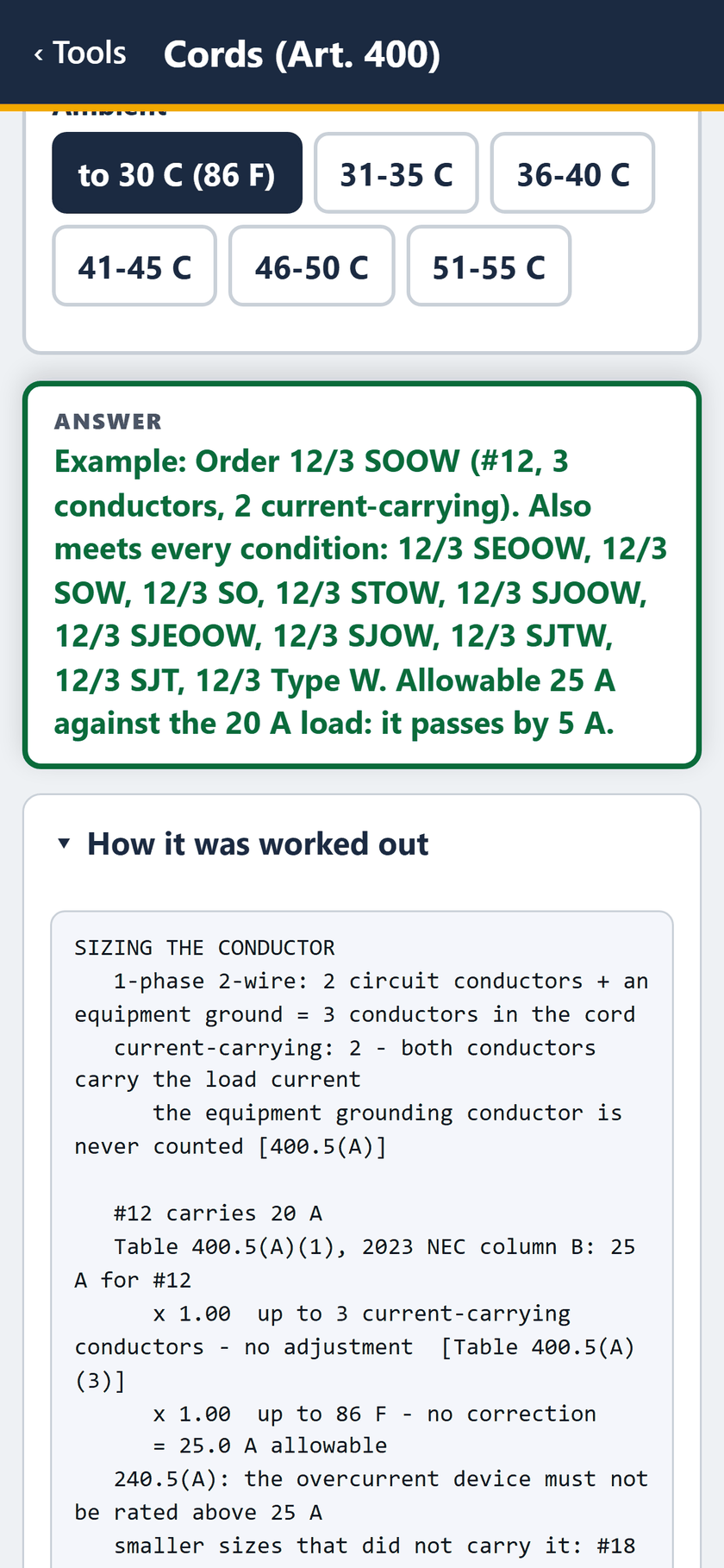
  5. Cords (Art. 400) screen: Ambient to 30 C (86 F). The answer: order 12/3 SOOW, allowable 25 A against the 20 A load, passing by 5 A.
    STEP 5 OF 20Ambient to 30 C (86 F). The answer: order 12/3 SOOW, allowable 25 A against the 20 A load, passing by 5 A.

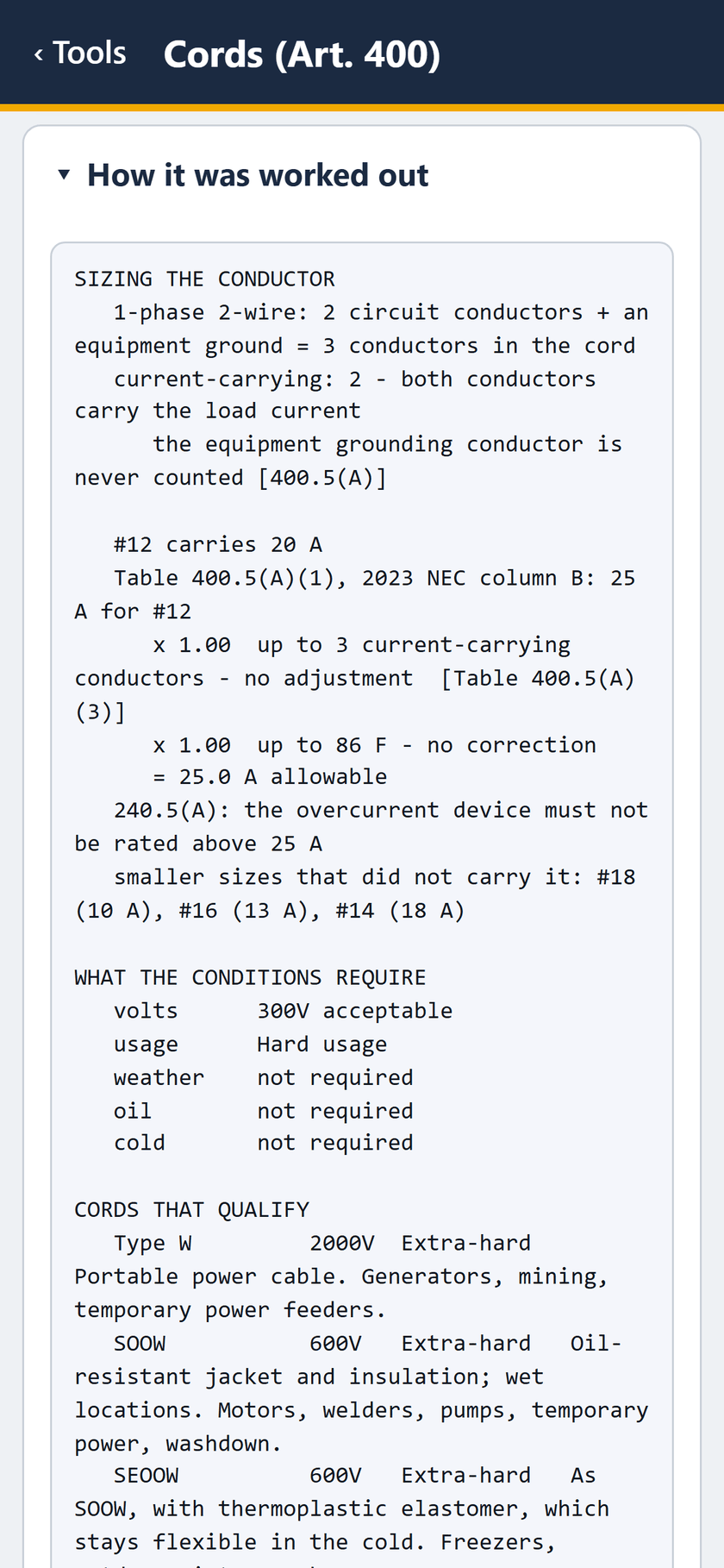
  6. Cords (Art. 400) screen: How it was worked out: 2 current-carrying, column B, 25 A for #12. The device must not be rated above 25 A.
    STEP 6 OF 20How it was worked out: 2 current-carrying, column B, 25 A for #12. The device must not be rated above 25 A.

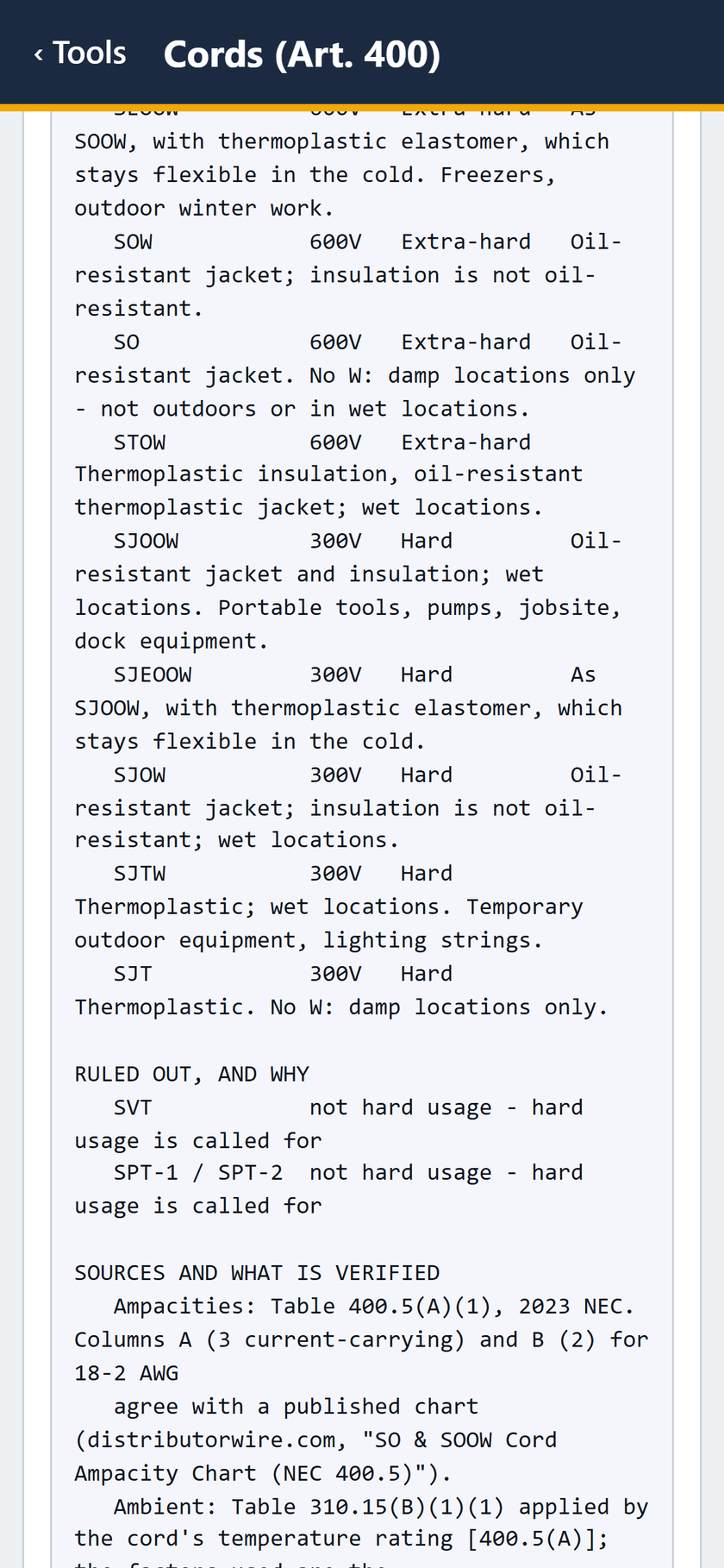
  7. Cords (Art. 400) screen: More cords that qualify, SEOOW to SJT, with voltage and usage. Ruled out: SVT and SPT-1 / SPT-2, not hard usage.
    STEP 7 OF 20More cords that qualify, SEOOW to SJT, with voltage and usage. Ruled out: SVT and SPT-1 / SPT-2, not hard usage.

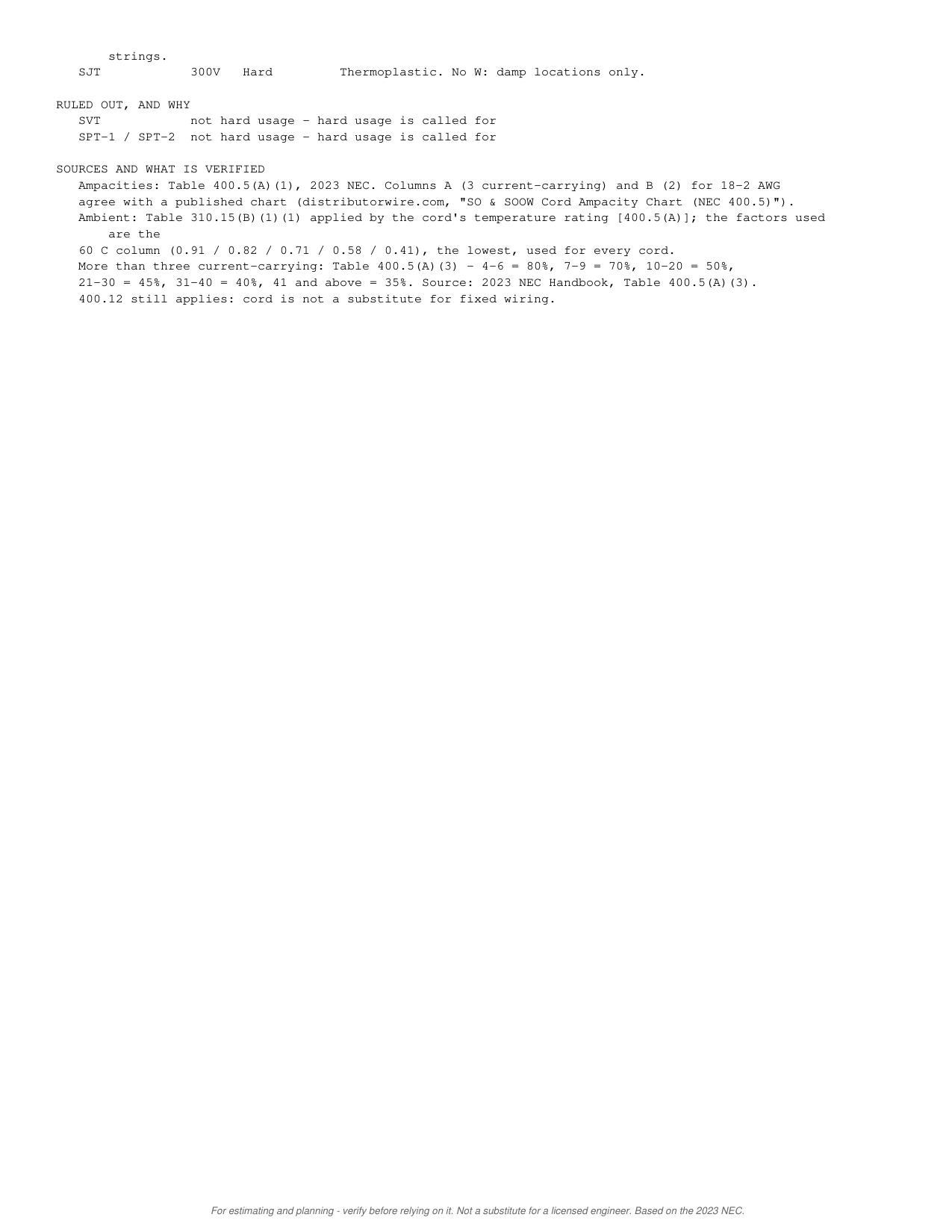
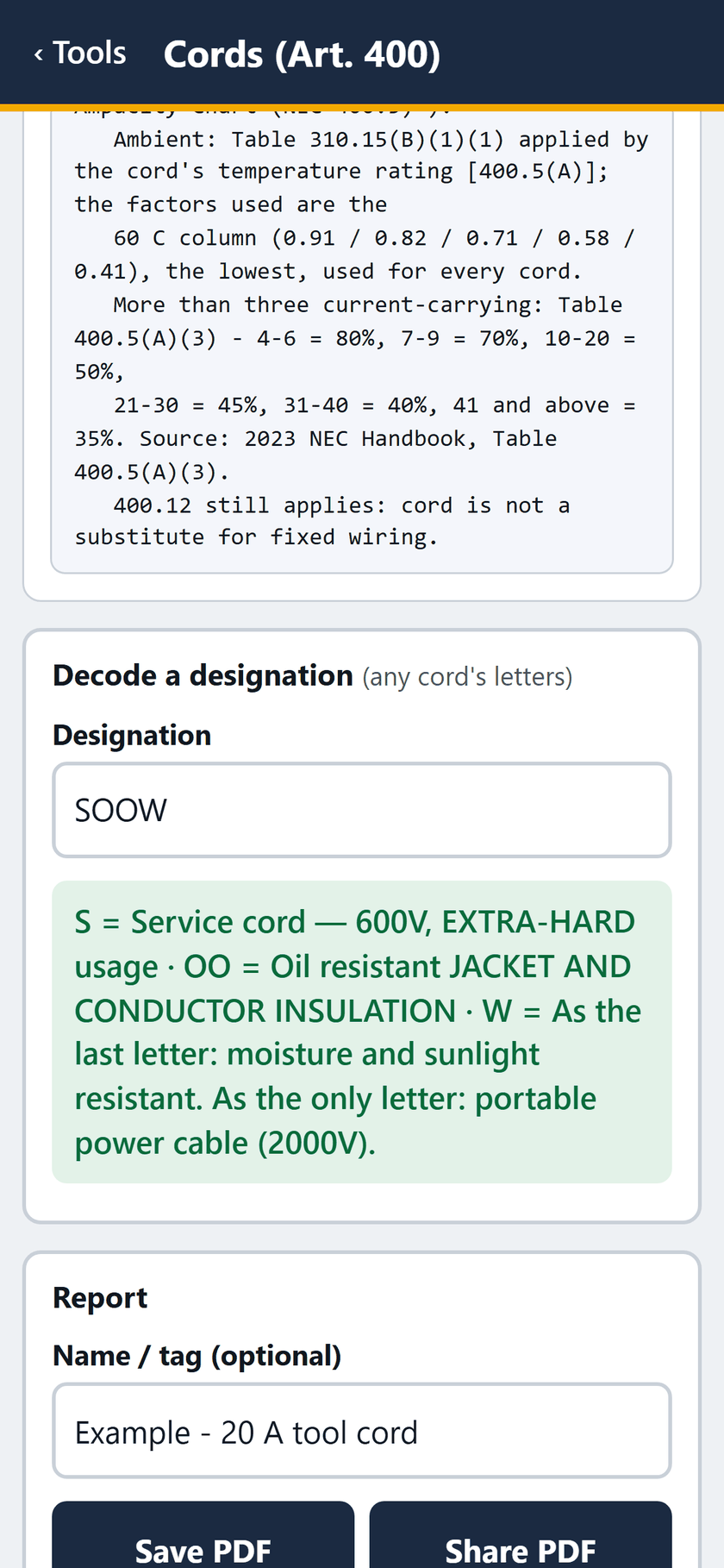
  8. Cords (Art. 400) screen: The sources and what is verified, then the decoder: SOOW read letter by letter.
    STEP 8 OF 20The sources and what is verified, then the decoder: SOOW read letter by letter.

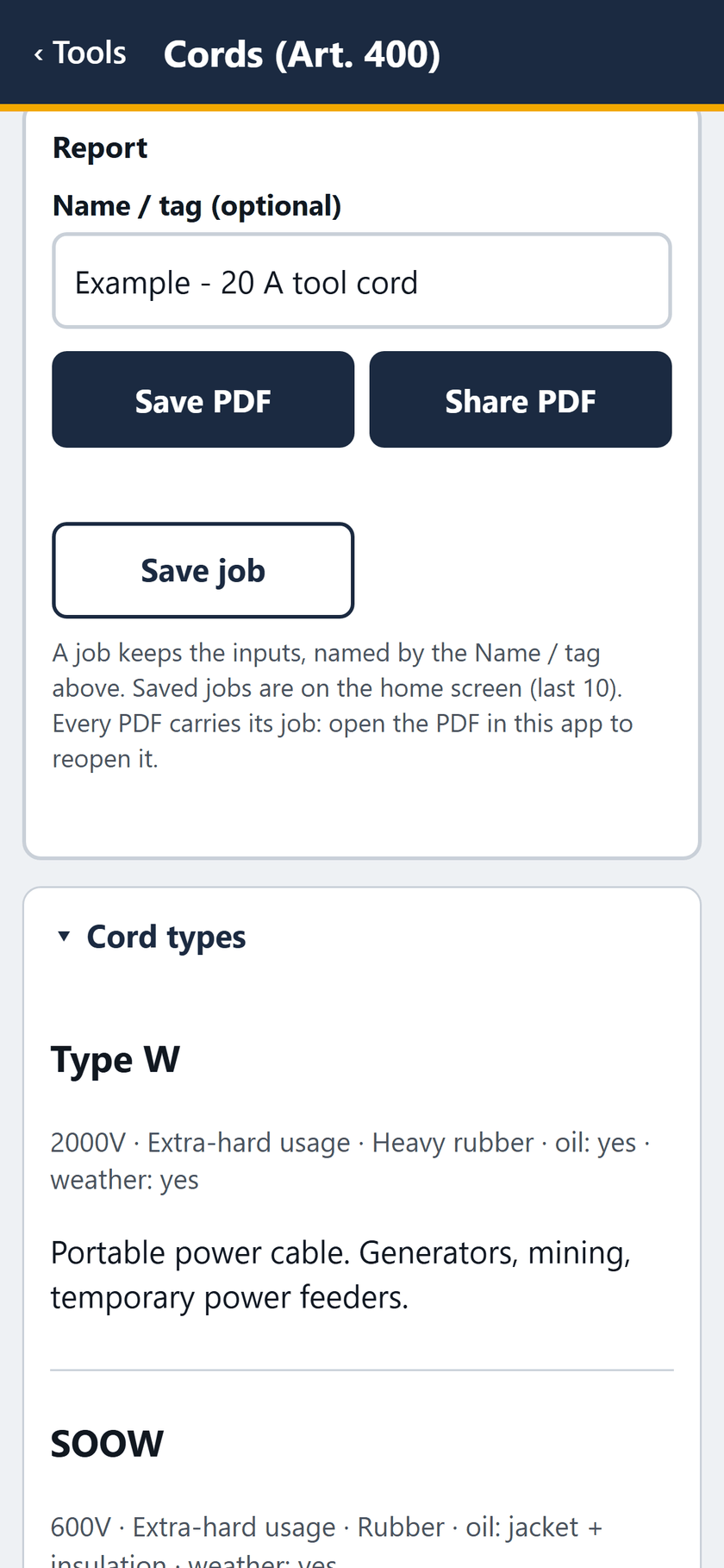
  9. Cords (Art. 400) screen: The report: save or share the PDF, or save the job. Below it, the cord types begin.
    STEP 9 OF 20The report: save or share the PDF, or save the job. Below it, the cord types begin.

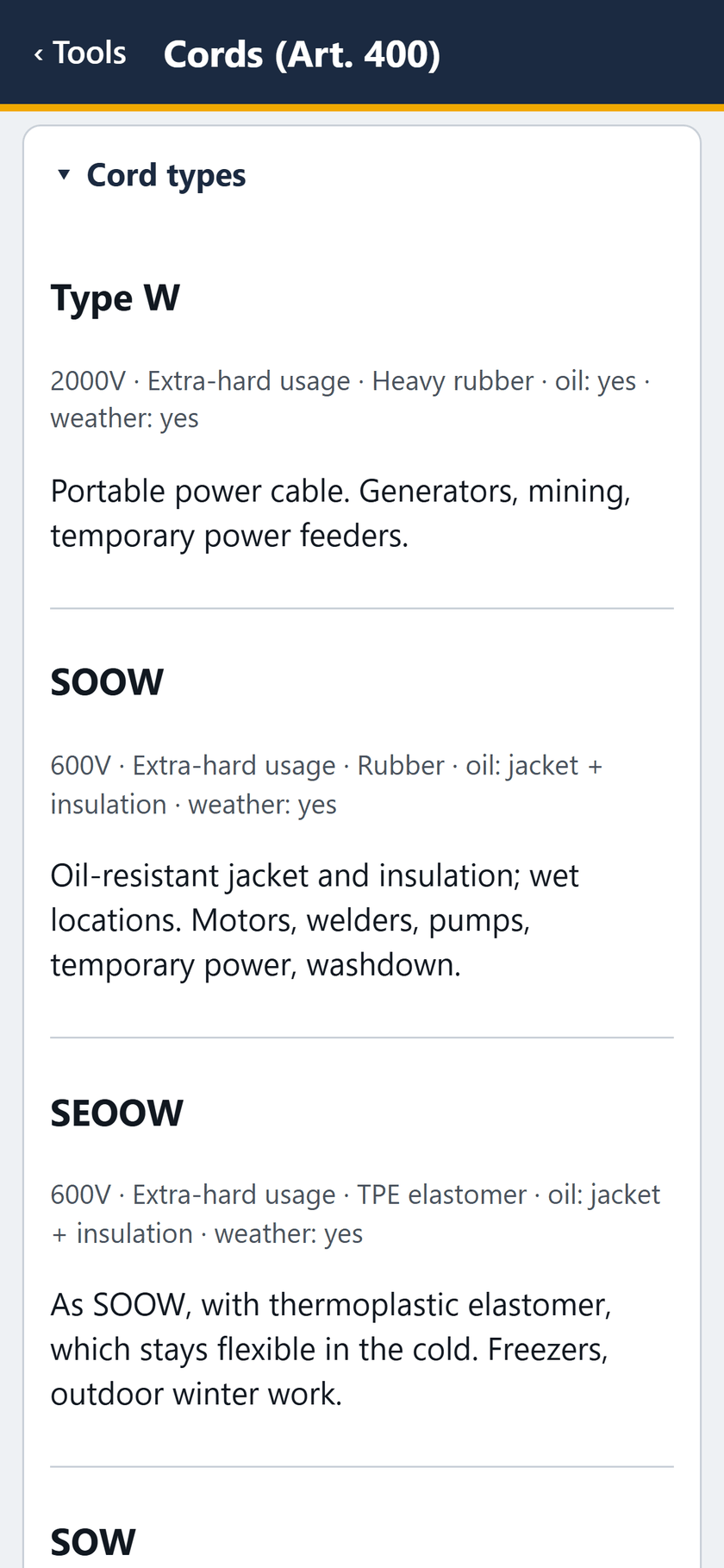
  10. Cords (Art. 400) screen: Cord types: Type W at 2000V, SOOW and SEOOW at 600V extra-hard usage.
    STEP 10 OF 20Cord types: Type W at 2000V, SOOW and SEOOW at 600V extra-hard usage.

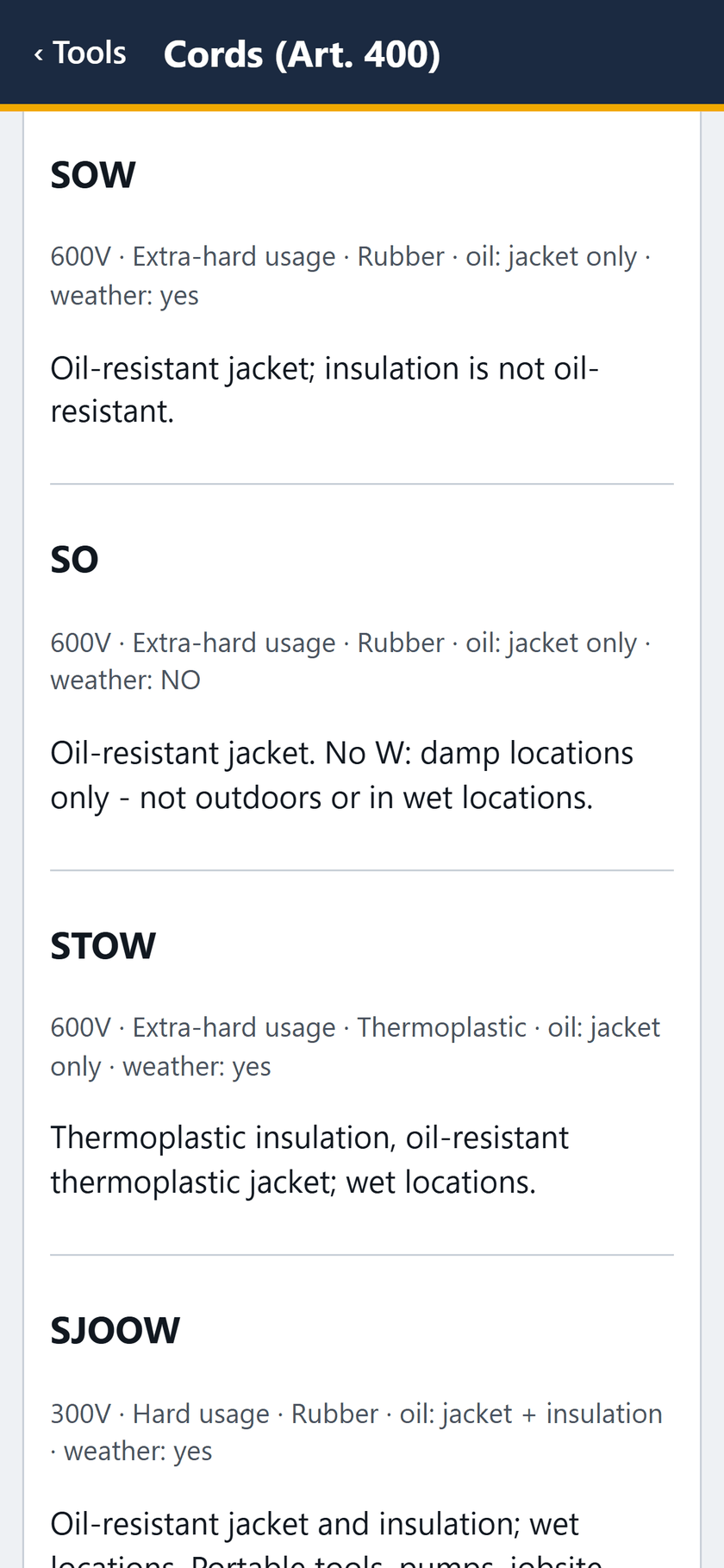
  11. Cords (Art. 400) screen: SOW, SO, STOW and SJOOW. SO has no W: damp locations only.
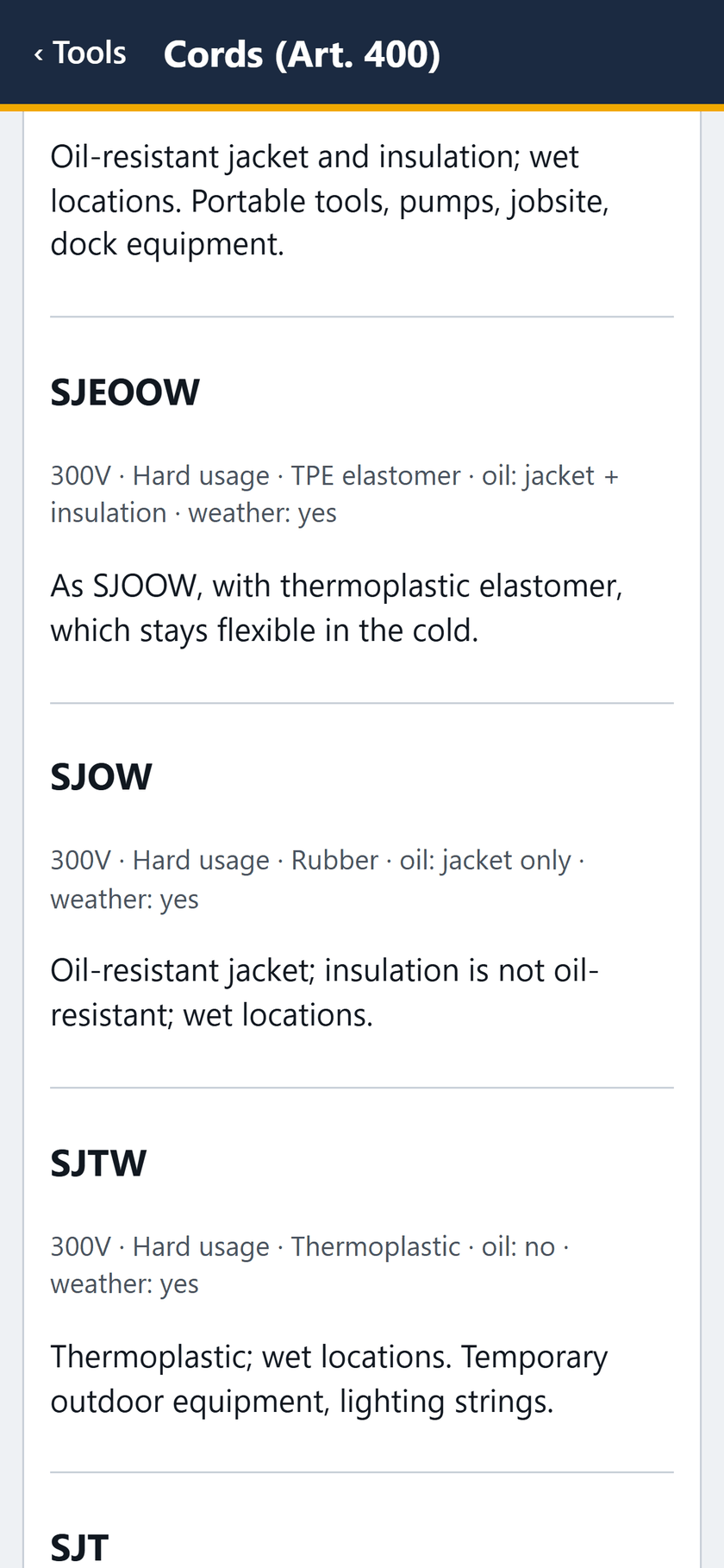
    STEP 11 OF 20SOW, SO, STOW and SJOOW. SO has no W: damp locations only.

  12. Cords (Art. 400) screen: SJEOOW, SJOW and SJTW: 300V hard usage.
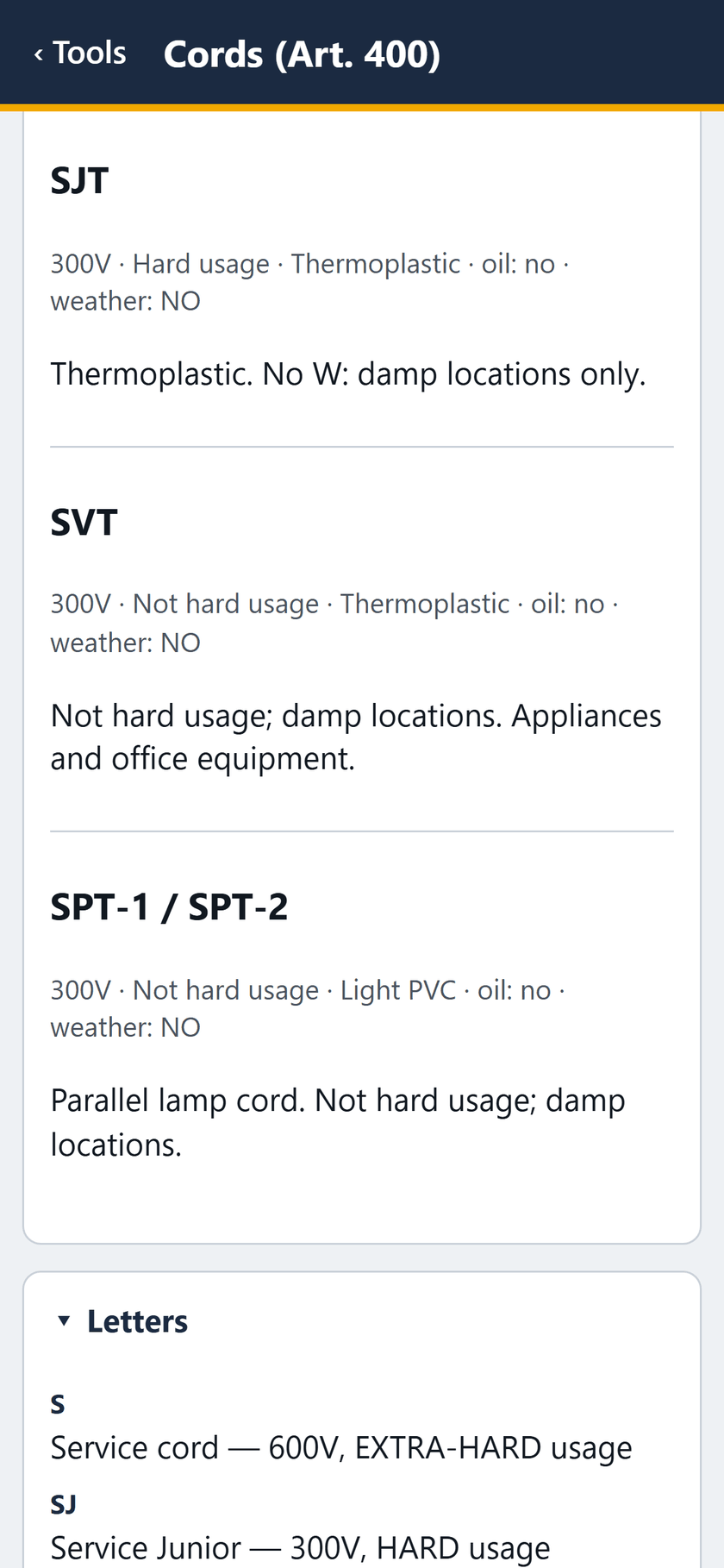
    STEP 12 OF 20SJEOOW, SJOW and SJTW: 300V hard usage.

  13. Cords (Art. 400) screen: SJT, SVT and SPT-1 / SPT-2, all weather: NO. Then the letters begin.
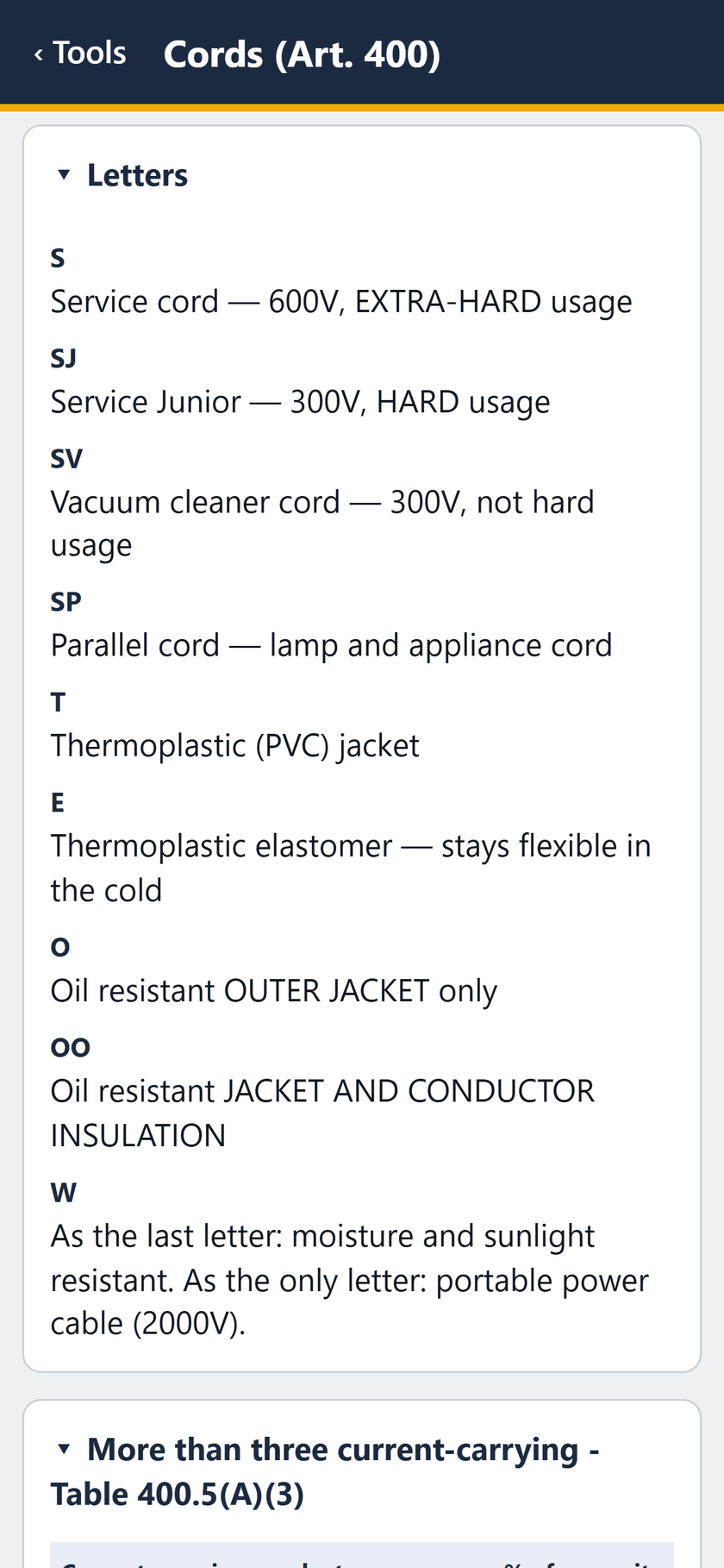
    STEP 13 OF 20SJT, SVT and SPT-1 / SPT-2, all weather: NO. Then the letters begin.

  14. Cords (Art. 400) screen: The letters: S, SJ, SV, SP, T, E, O, OO and W.
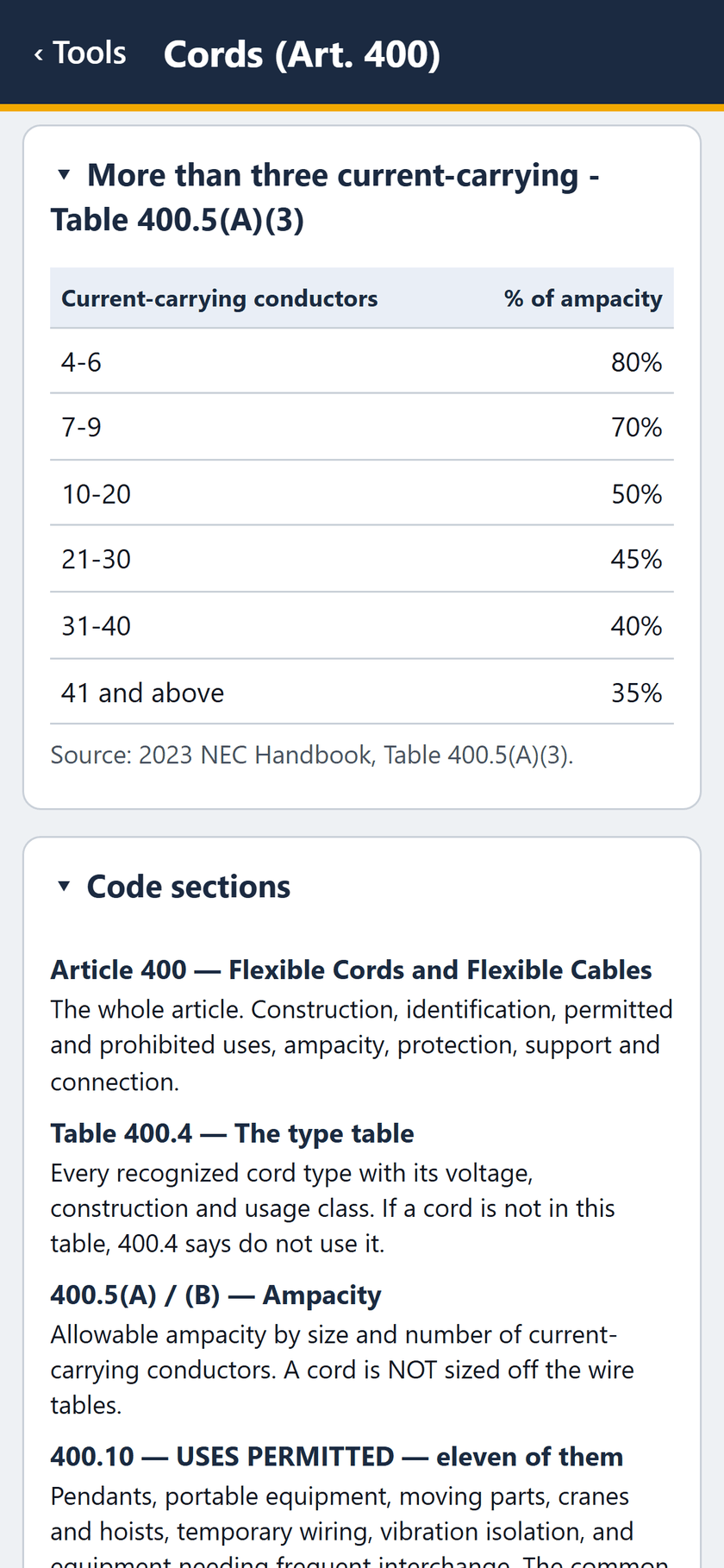
    STEP 14 OF 20The letters: S, SJ, SV, SP, T, E, O, OO and W.

  15. Cords (Art. 400) screen: Table 400.5(A)(3), 4-6 at 80% down to 41 and above at 35%. Then the code sections.
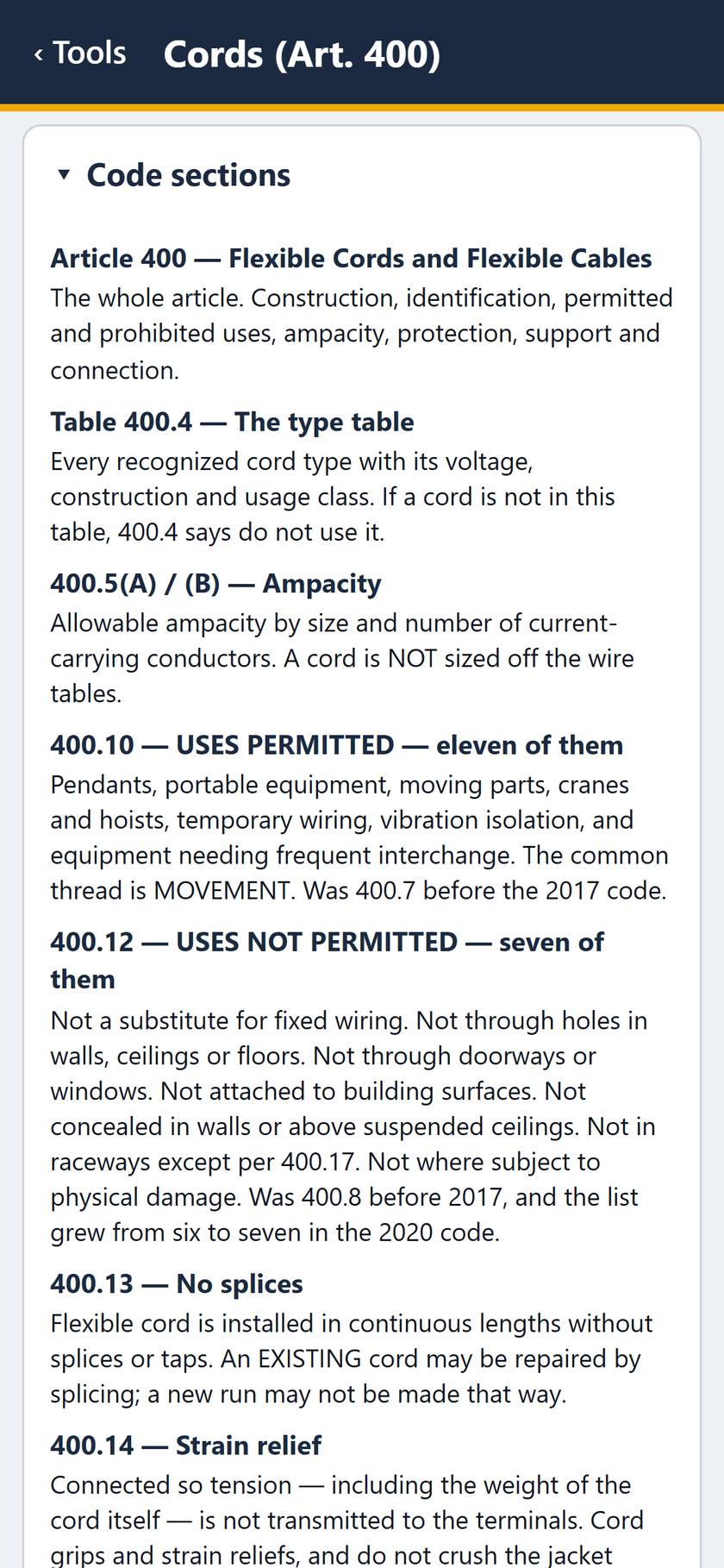
    STEP 15 OF 20Table 400.5(A)(3), 4-6 at 80% down to 41 and above at 35%. Then the code sections.

  16. Cords (Art. 400) screen: Code sections: Article 400, Table 400.4, 400.5, 400.10 uses permitted, 400.12 uses not permitted, 400.13 and 400.14.
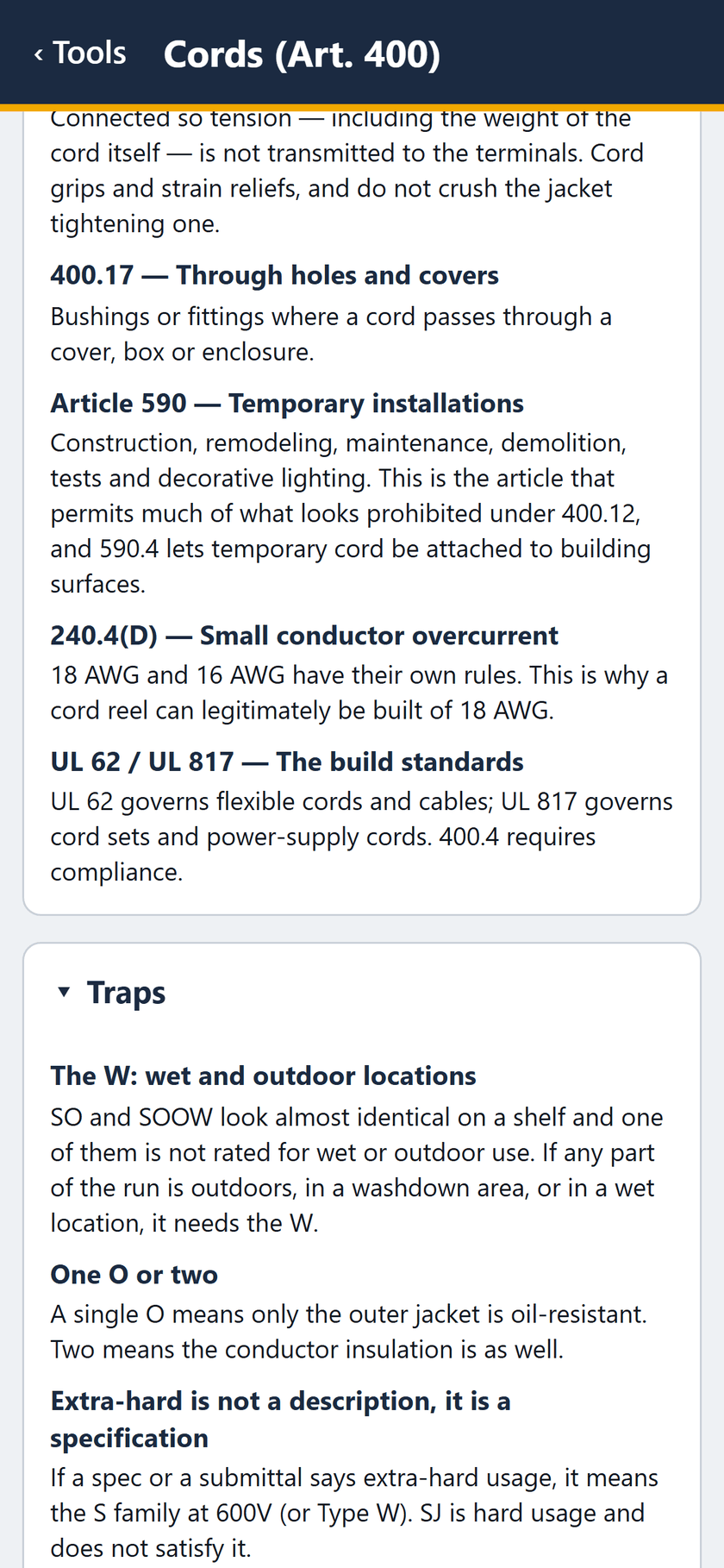
    STEP 16 OF 20Code sections: Article 400, Table 400.4, 400.5, 400.10 uses permitted, 400.12 uses not permitted, 400.13 and 400.14.

  17. Cords (Art. 400) screen: 400.17, Article 590, 240.4(D) and UL 62 / UL 817. Then the traps: the W, and one O or two.

    STEP 17 OF 20400.17, Article 590, 240.4(D) and UL 62 / UL 817. Then the traps: the W, and one O or two.
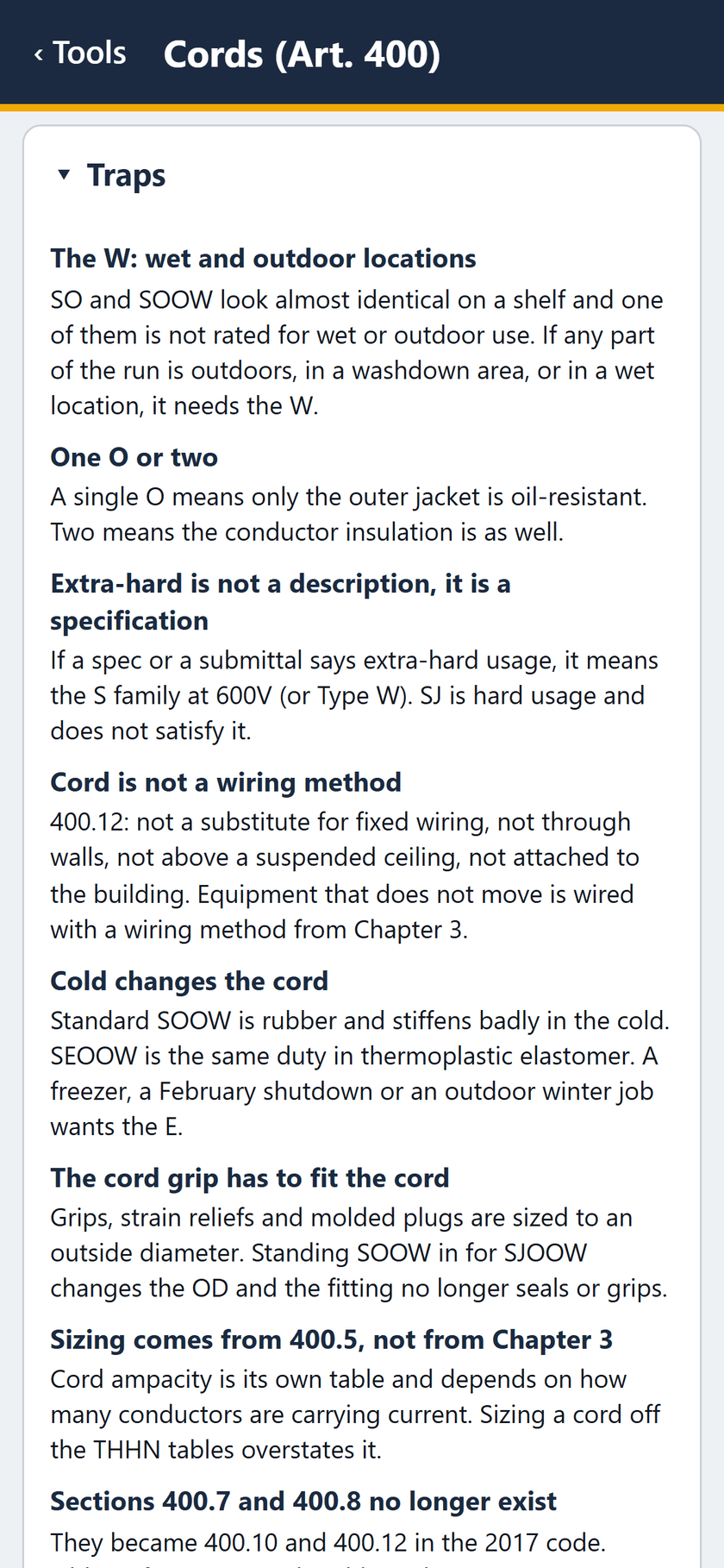
  18. Cords (Art. 400) screen: The traps: extra-hard is a specification, cord is not a wiring method, cold changes the cord, the grip has to fit.
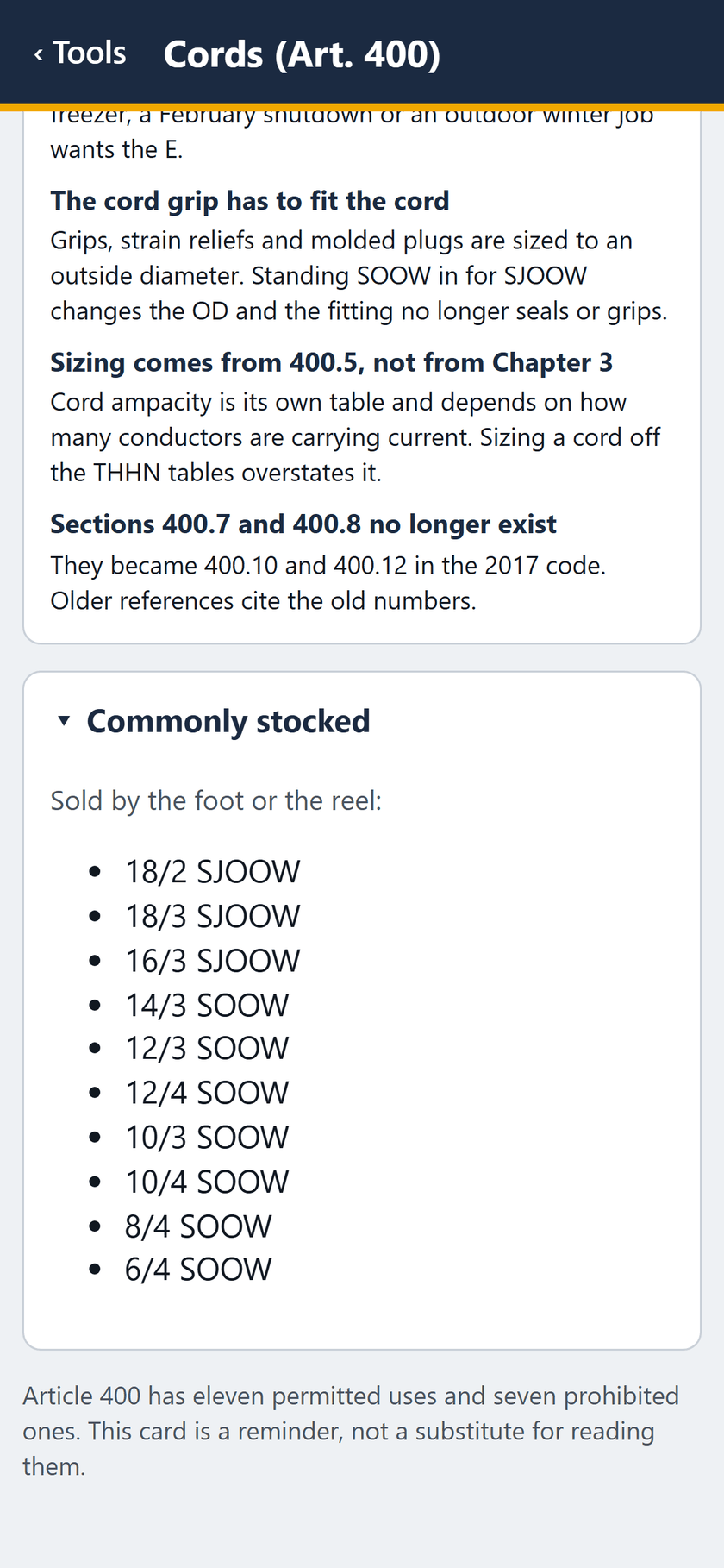
    STEP 18 OF 20The traps: extra-hard is a specification, cord is not a wiring method, cold changes the cord, the grip has to fit.

  19. Cords (Art. 400) screen: The last traps, then the cords commonly stocked, 18/2 SJOOW to 6/4 SOOW.
    STEP 19 OF 20The last traps, then the cords commonly stocked, 18/2 SJOOW to 6/4 SOOW.

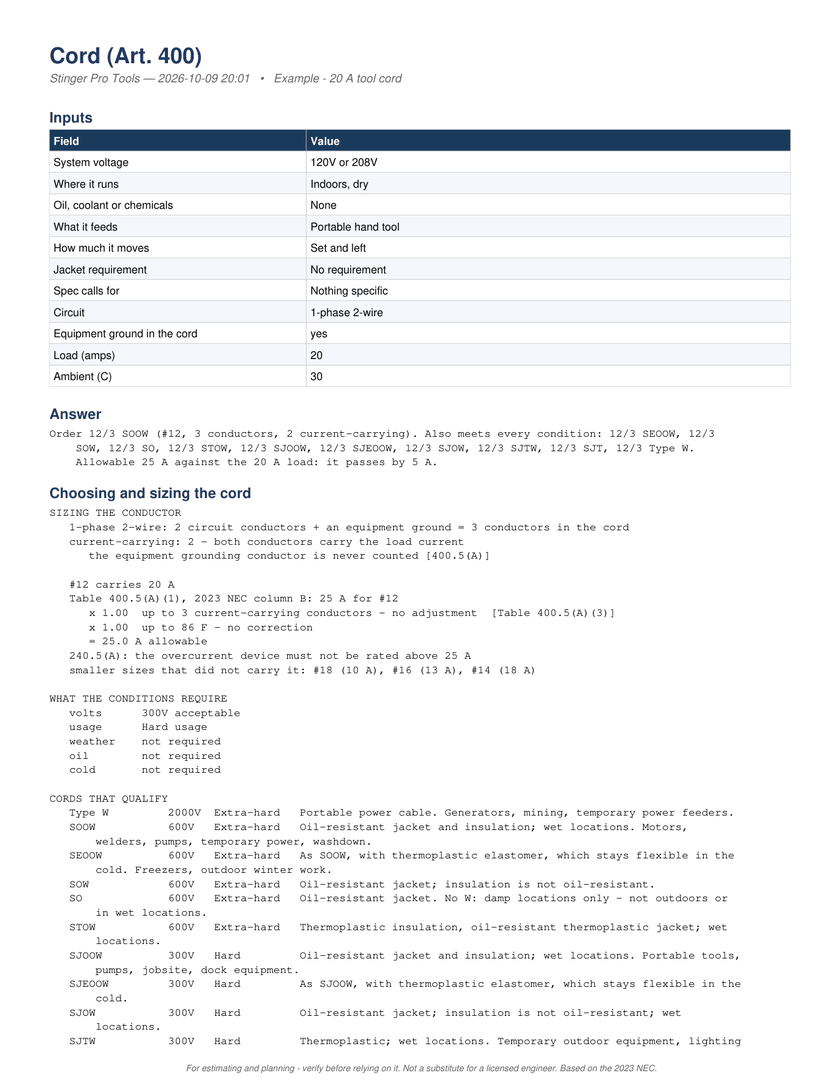
  20. Page 1 of the PDF report: The PDF, page 1: the inputs, the answer, and choosing and sizing the cord.

    STEP 20 OF 20The PDF, page 1: the inputs, the answer, and choosing and sizing the cord.

B

One job, start to finish — video

The same 20 screens with the captions burned in. No sound.

MP4, 2.6 MB, 21 seconds.

The report

The PDF report for the same job, all 2 pages as the app writes it.
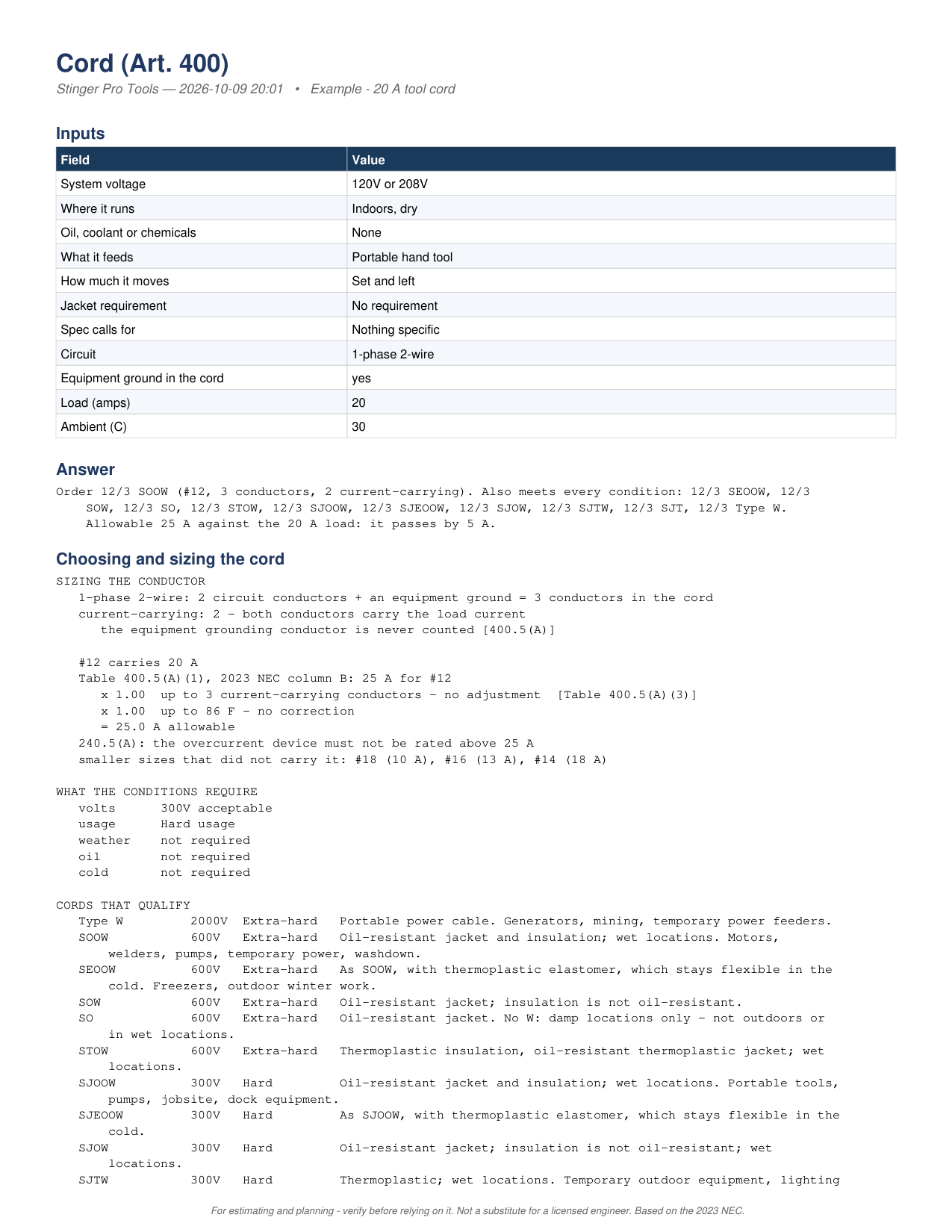
Page 1 of the Cords (Art. 400) PDF report
Page 1
Page 2 of the Cords (Art. 400) PDF report
Page 2
Where it runs

Two places to run it

Stinger Pro Tools

On Android, $49.99 once. Everything on this page.

Get it on Google Play

The Stinger Pro Suite

The cord chooser was first built in the Suite. The app counts current-carrying conductors from the circuit type instead of from the conductors in the cord, has Type W at 2000V, completes Table 400.5(A)(3), and adds the order name, the margin and Article 590. These are being brought back across.

Join the Suite’s early-access list →