Conduit Fill

Conduit Fill takes the conduit type, the conductors, and the load, voltage and run length, and gives back the smallest conduit with its fill, plus a recommended conductor, EGC and breaker with the voltage drop.

The platform - now showing Conduit Fill

The drawing

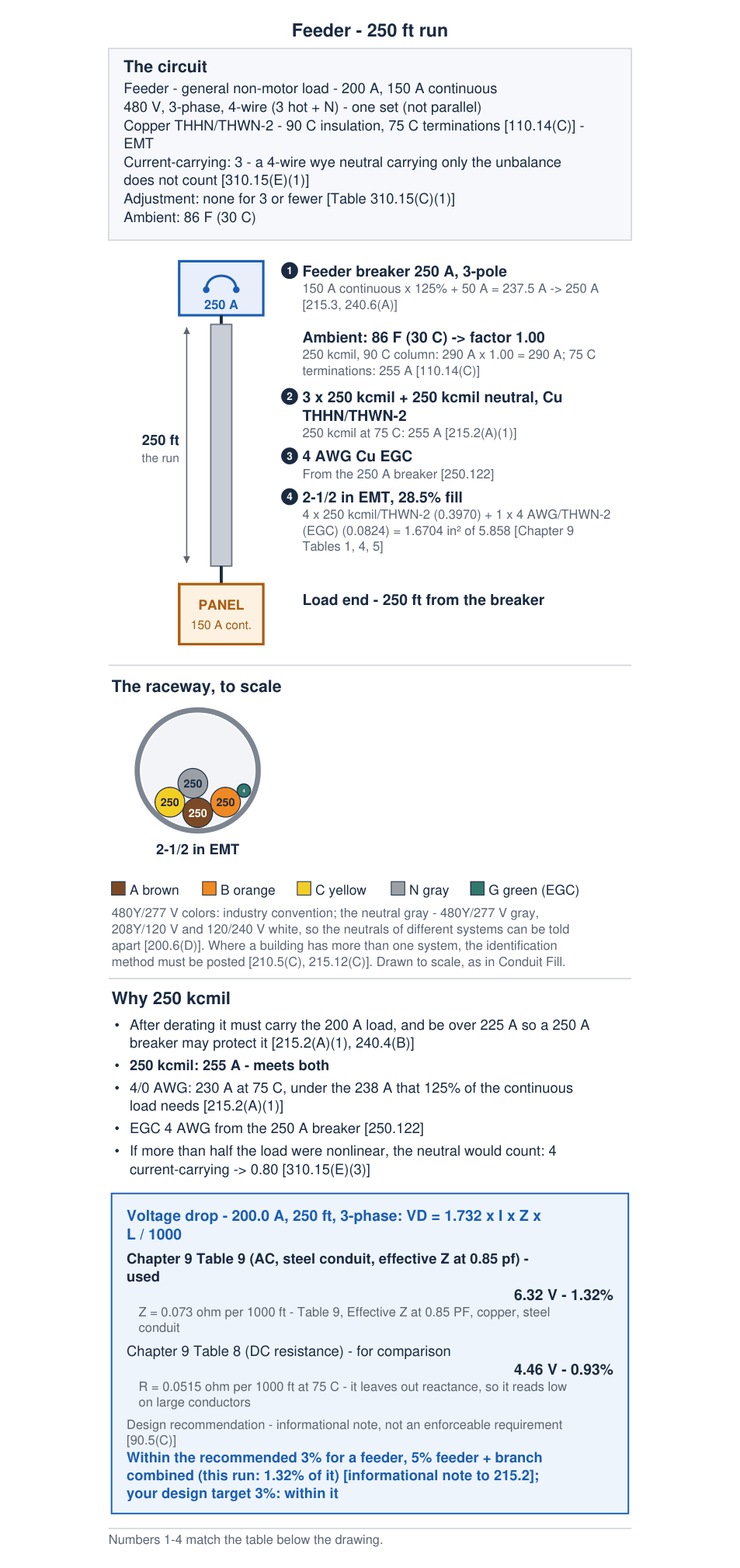
The same 200 A, 250 ft feeder worked out at two voltages. The report draws the circuit, the raceway to scale in the system’s conductor colors, and why the program chose the conductor it did.
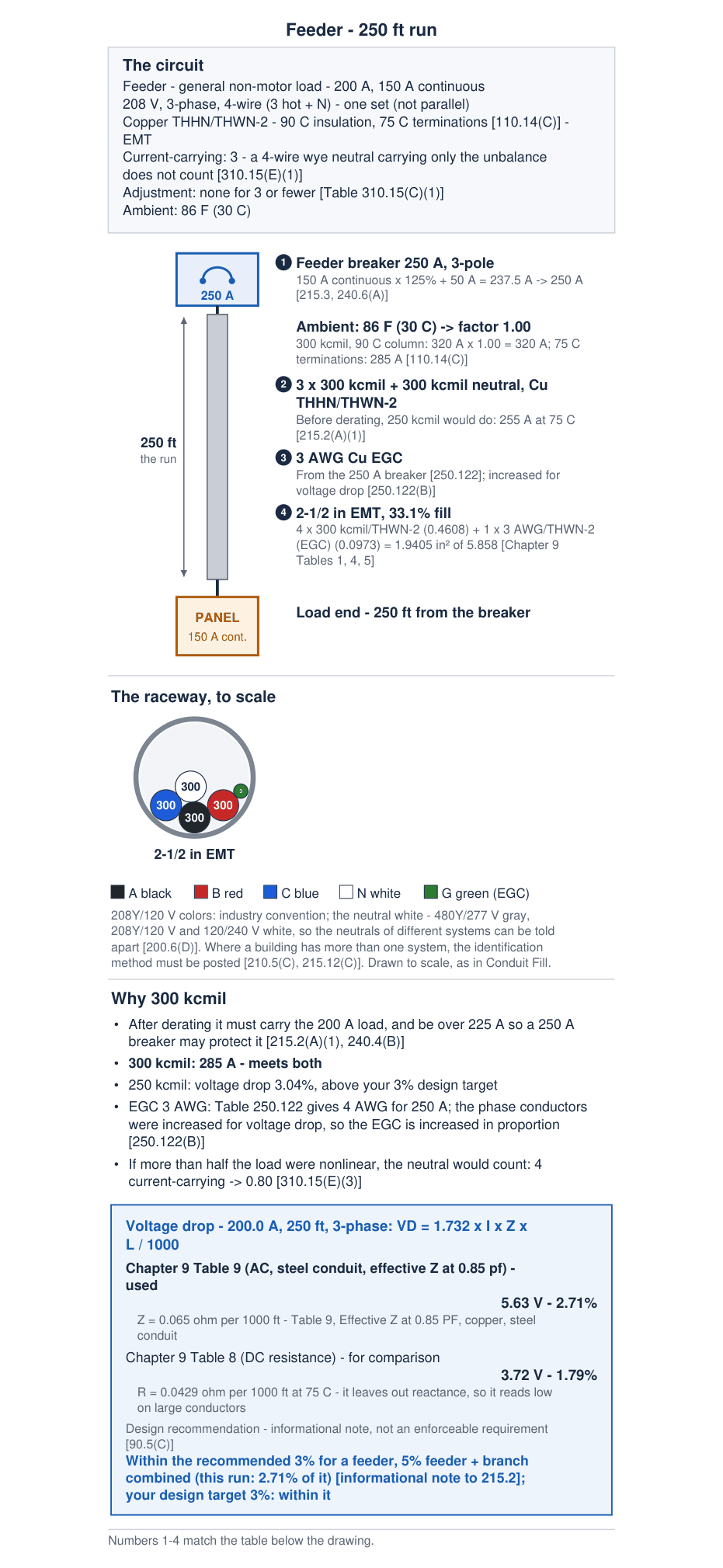
Drawing the program wrote: At 208 V: phases black, red and blue, the neutral white. Voltage drop governs, so 300 kcmil is chosen (250 kcmil would drop 3.04%) and the EGC goes up to 3 AWG in proportion; 2.71% drop, 33.1% fill in 2-1/2 in EMT.
At 208 V: phases black, red and blue, the neutral white. Voltage drop governs, so 300 kcmil is chosen (250 kcmil would drop 3.04%) and the EGC goes up to 3 AWG in proportion; 2.71% drop, 33.1% fill in 2-1/2 in EMT.
Drawing the program wrote: At 480 V: phases brown, orange and yellow, the neutral gray. The drop is only 1.32%, so the 125% continuous load governs: 250 kcmil with a 4 AWG EGC, 28.5% fill in the same 2-1/2 in EMT.
At 480 V: phases brown, orange and yellow, the neutral gray. The drop is only 1.32%, so the 125% continuous load governs: 250 kcmil with a 4 AWG EGC, 28.5% fill in the same 2-1/2 in EMT.

The report it writes

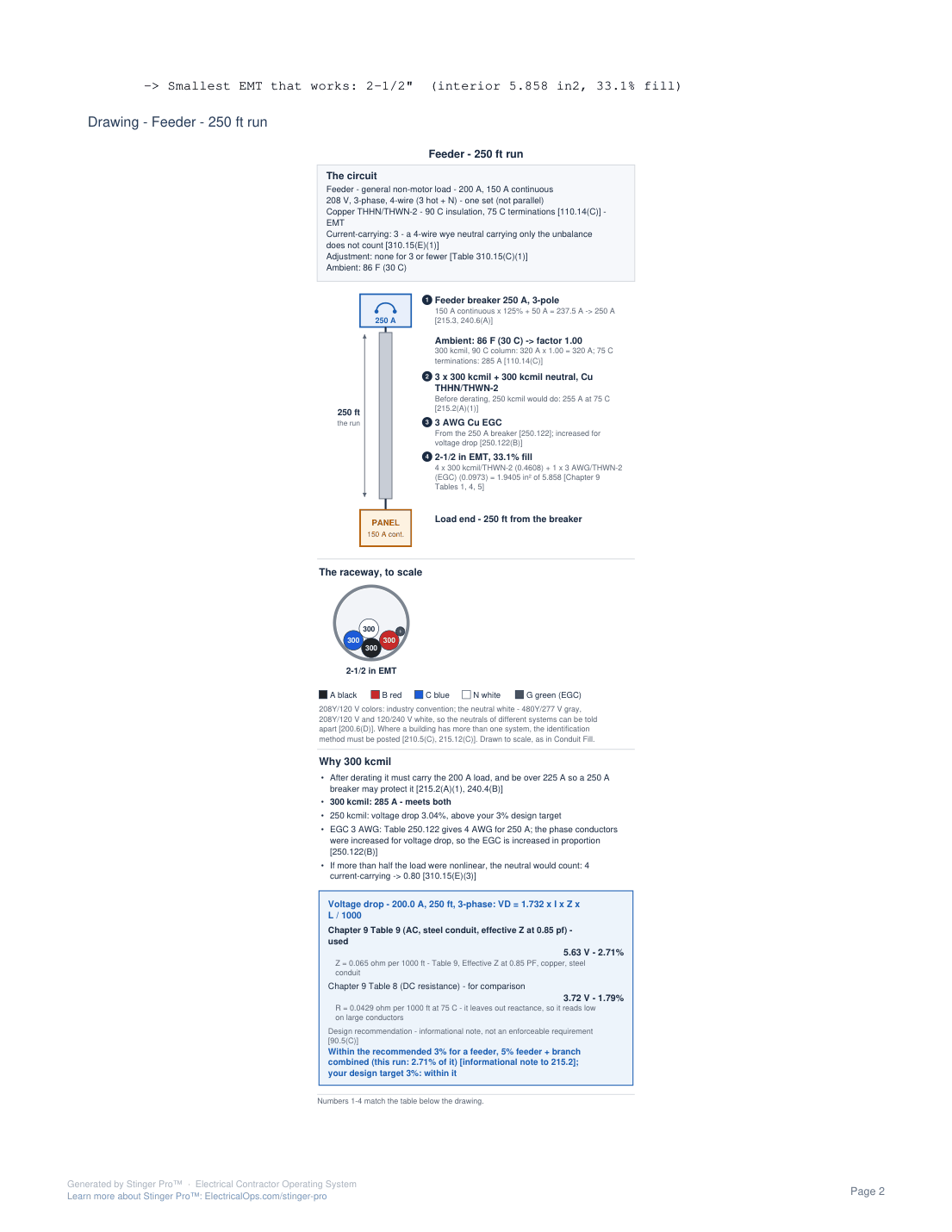
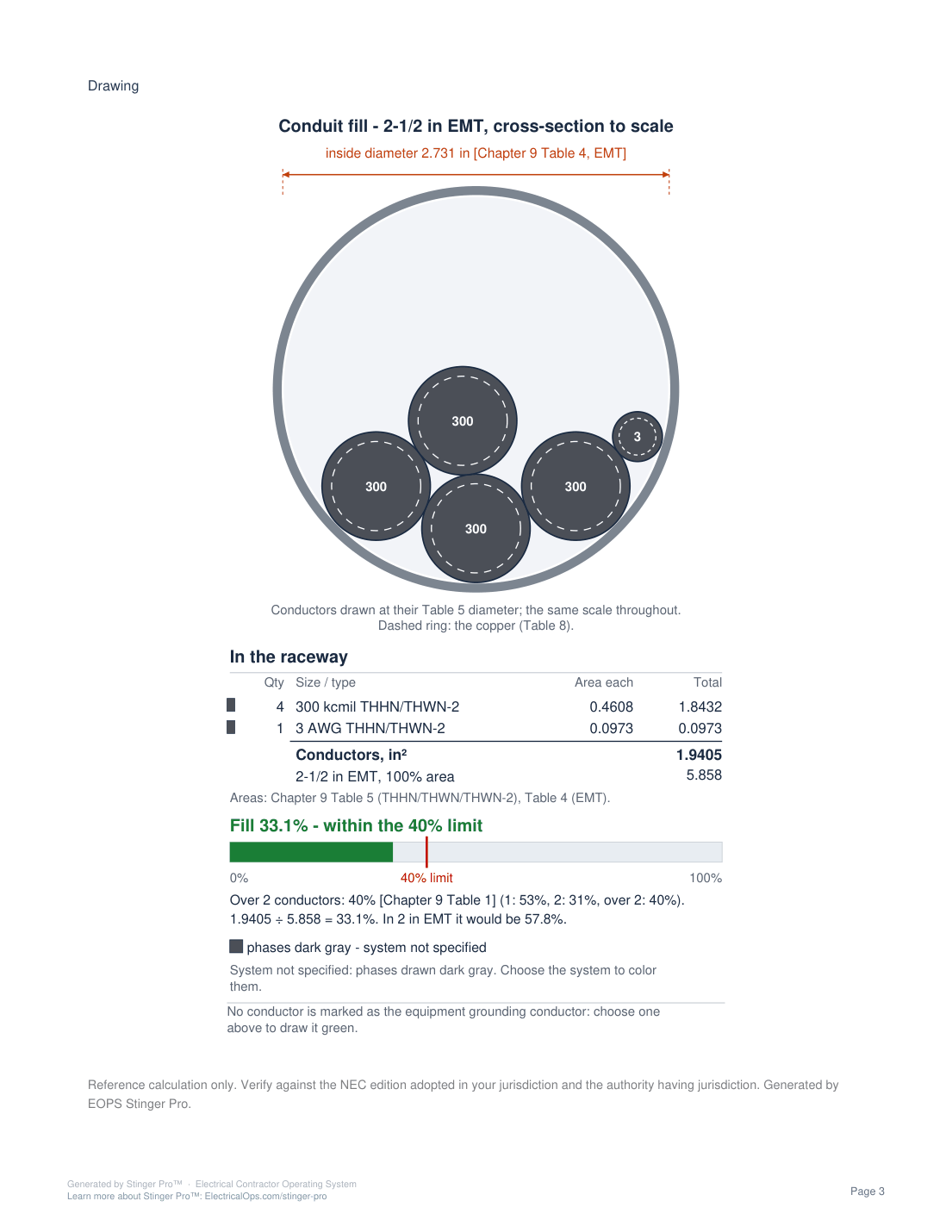
The report the Suite wrote for the 208 V feeder: three pages.
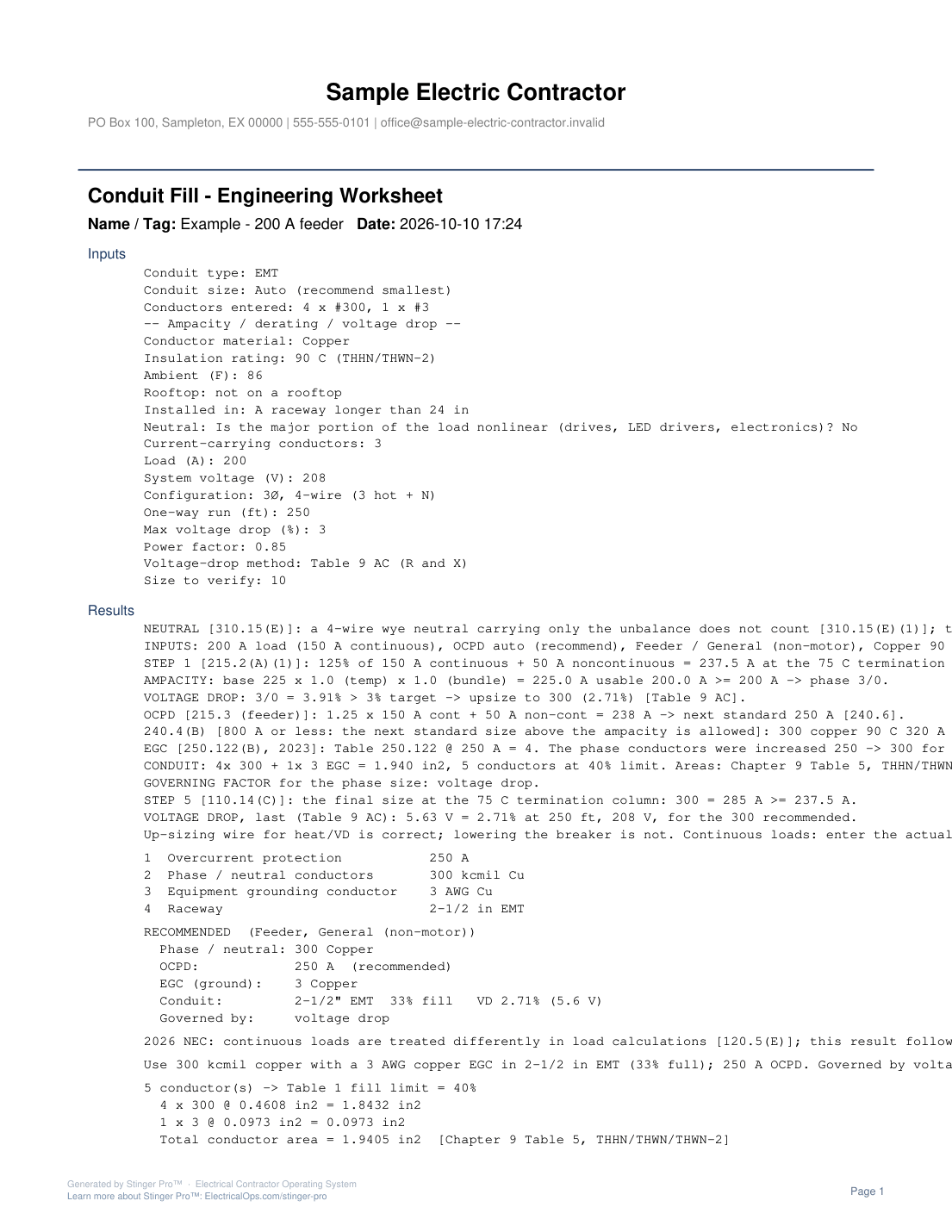
Report page the program wrote: Page 1 of 3
Page 1 of 3
Report page the program wrote: Page 2 of 3
Page 2 of 3
Report page the program wrote: Page 3 of 3
Page 3 of 3

Page 1 lists every input and the work line by line with its NEC section; page 2 is the feeder drawing with the voltage drop; page 3 is the cross-section and the fill table.

The example, step by step

The phone app's example job, Example - 200 A feeder, opened with Open phone job… and worked out by the Suite.
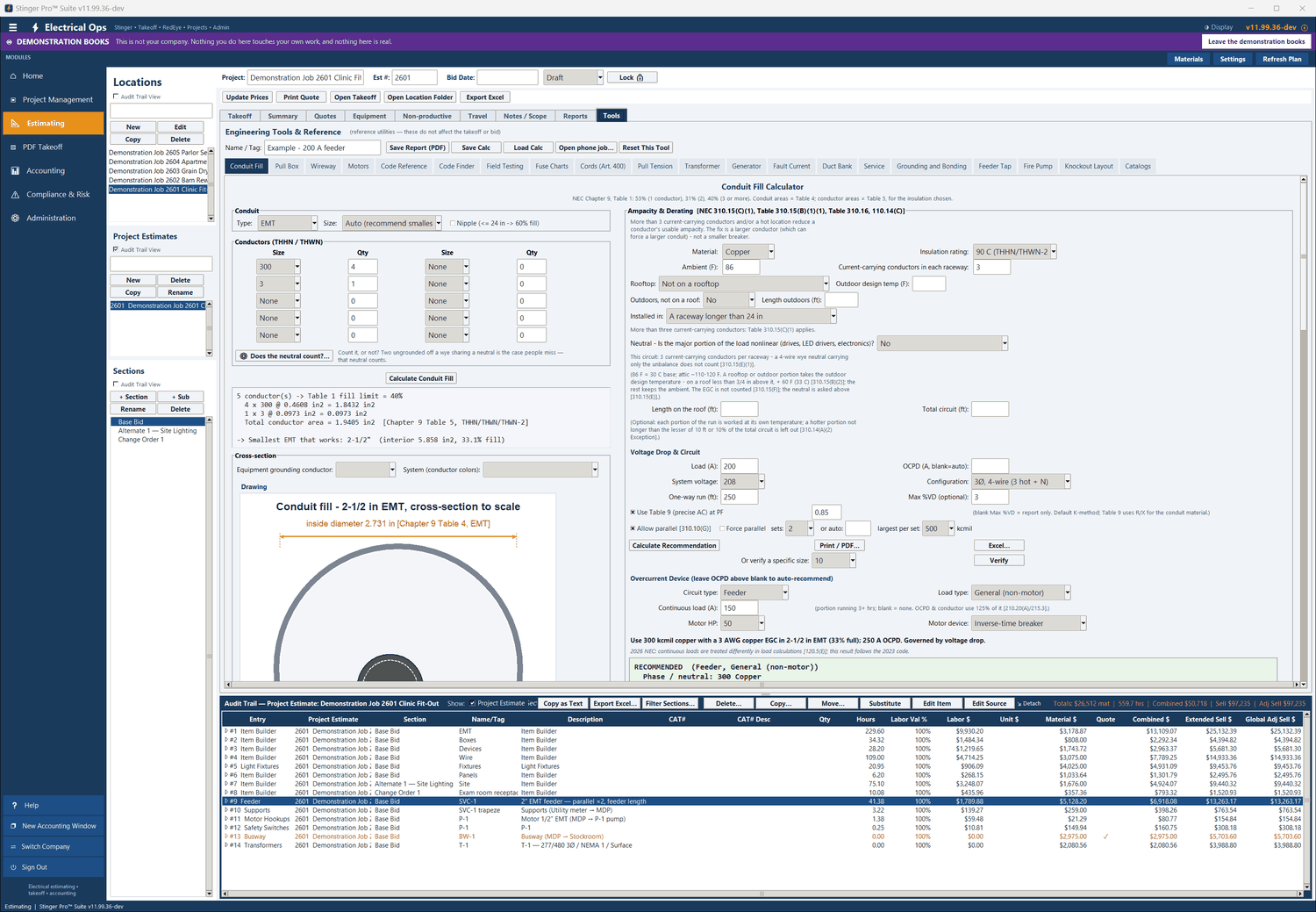
  1. Conduit Fill in Stinger Pro: The example in the tool: four 300 kcmil and one 3 AWG in EMT, 200 A at 208 V over 250 ft, 150 A continuous. Smallest EMT that works: 2-1/2 in at 33.1% fill.
    STEP 1 OF 5The example in the tool: four 300 kcmil and one 3 AWG in EMT, 200 A at 208 V over 250 ft, 150 A continuous. Smallest EMT that works: 2-1/2 in at 33.1% fill.

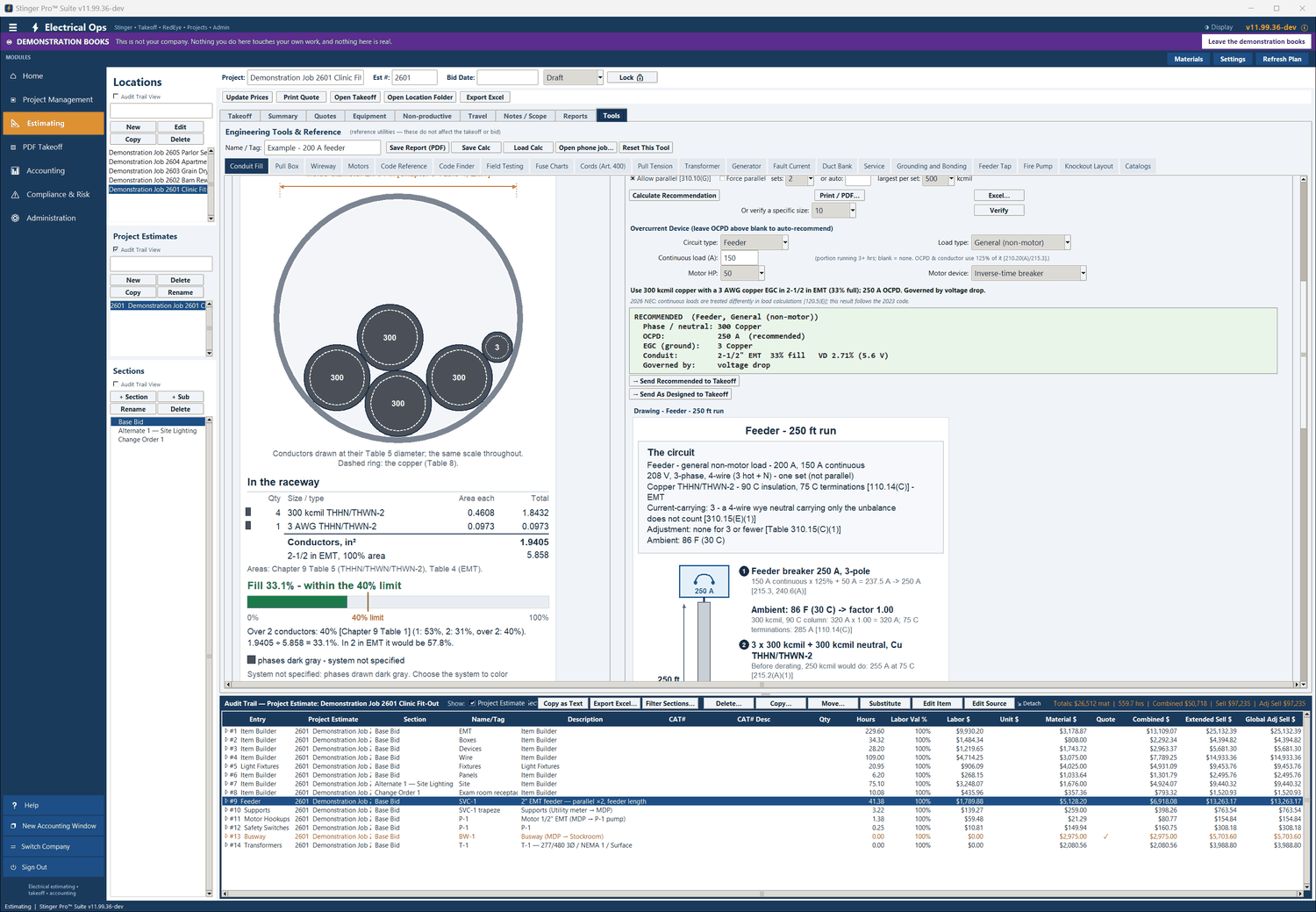
  2. Conduit Fill in Stinger Pro: The cross-section to scale beside the recommendation: 300 kcmil Cu, 250 A, 3 AWG EGC, 2-1/2 in EMT at 33% fill, 2.71% drop, governed by voltage drop.
    STEP 2 OF 5The cross-section to scale beside the recommendation: 300 kcmil Cu, 250 A, 3 AWG EGC, 2-1/2 in EMT at 33% fill, 2.71% drop, governed by voltage drop.

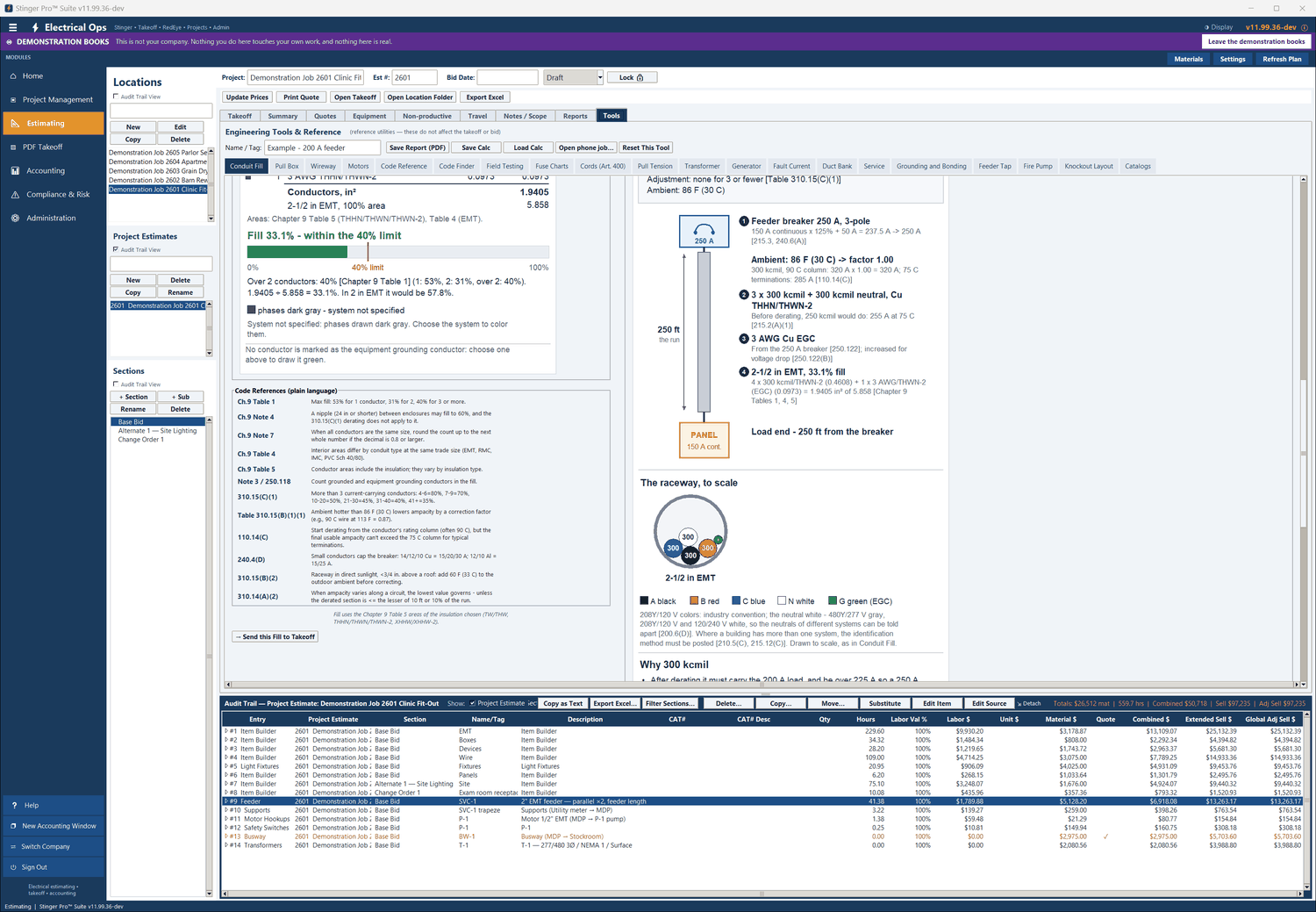
  3. Conduit Fill in Stinger Pro: The fill bar at 33.1% against the 40% limit, the code references in plain language, and the feeder drawing with the raceway in 208Y/120 V colors.
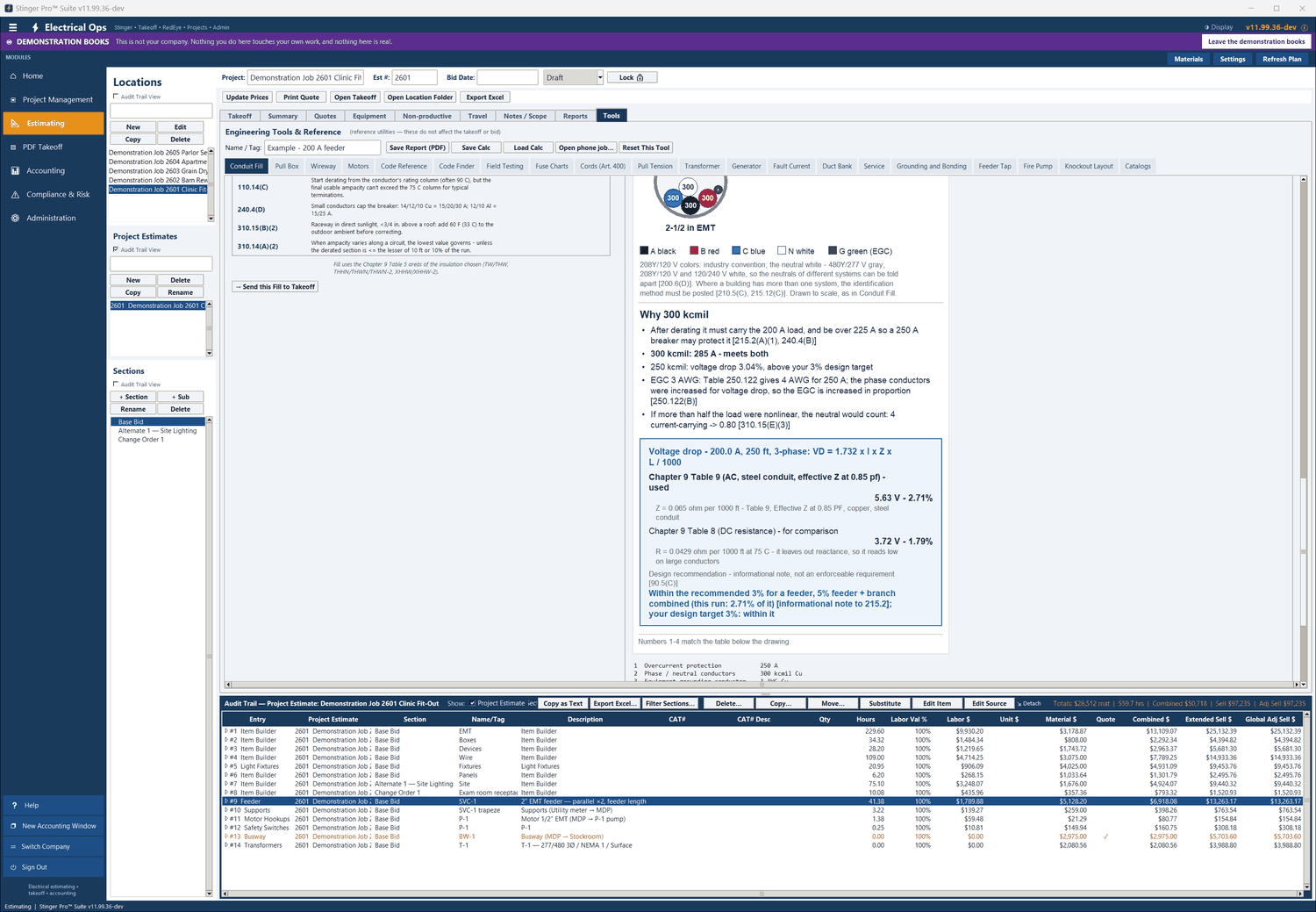
    STEP 3 OF 5The fill bar at 33.1% against the 40% limit, the code references in plain language, and the feeder drawing with the raceway in 208Y/120 V colors.

  4. Conduit Fill in Stinger Pro: Why 300 kcmil, and the voltage drop: Table 9 gives 5.63 V, 2.71%; Table 8 gives 3.72 V, 1.79% for comparison.
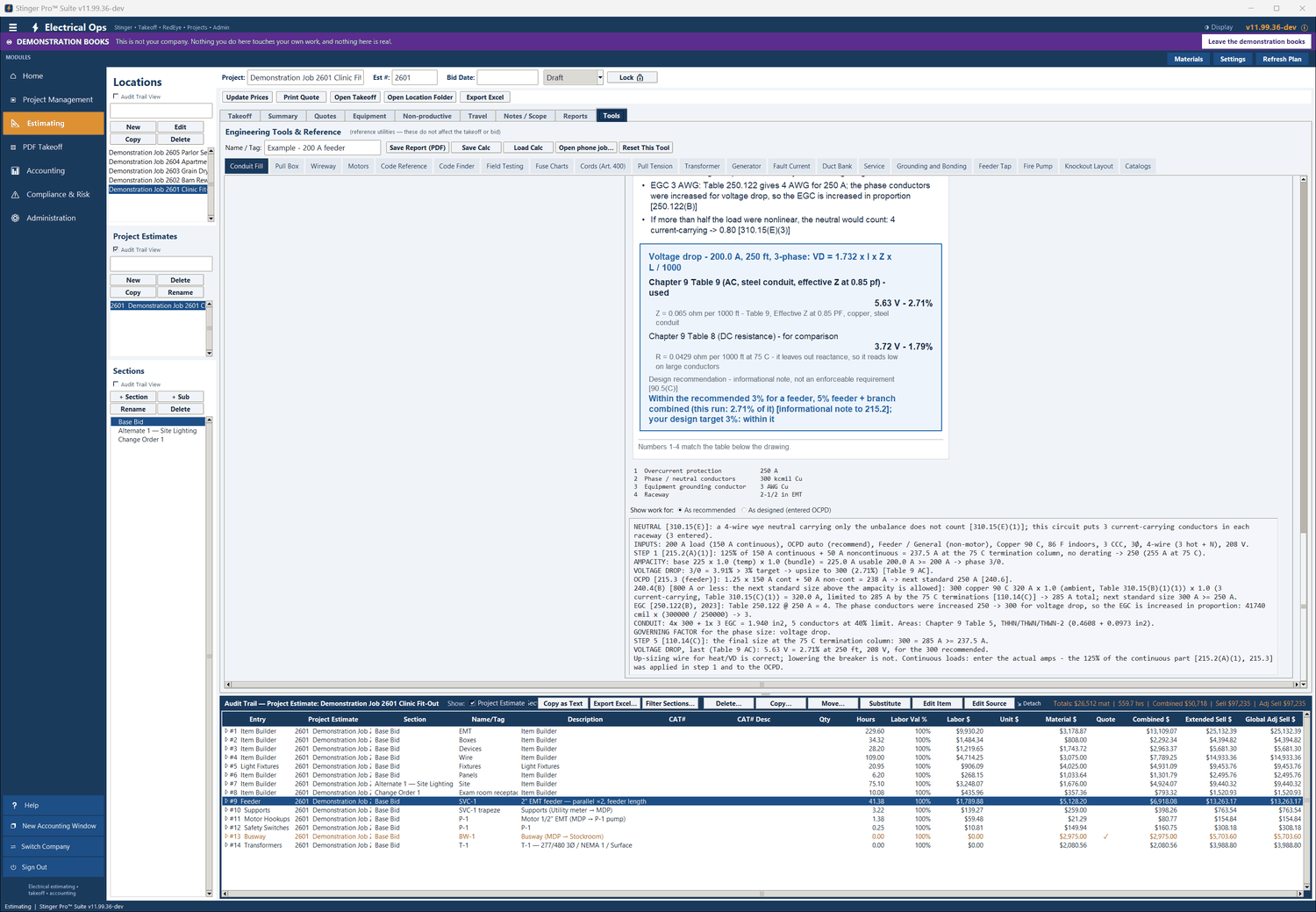
    STEP 4 OF 5Why 300 kcmil, and the voltage drop: Table 9 gives 5.63 V, 2.71%; Table 8 gives 3.72 V, 1.79% for comparison.

  5. Conduit Fill in Stinger Pro: The numbered summary (250 A, 300 kcmil Cu, 3 AWG Cu, 2-1/2 in EMT) and the work line by line, each line with its NEC section.

    STEP 5 OF 5The numbered summary (250 A, 300 kcmil Cu, 3 AWG Cu, 2-1/2 in EMT) and the work line by line, each line with its NEC section.

Opened from a takeoff entry, this tool sends its answer back into that entry: the three tools that do this.