Pull Box

Pull Box takes the conduits on each wall and the largest conductor, and gives back the minimum box width, height and depth, a standard box size, and where to punch each knockout.

The platform - now showing Pull Box

The drawing

The box drawn to scale from the front with the cover off, each conduit where its knockout goes, and the side view for the depth. The walls whose pull governs are named under the box.
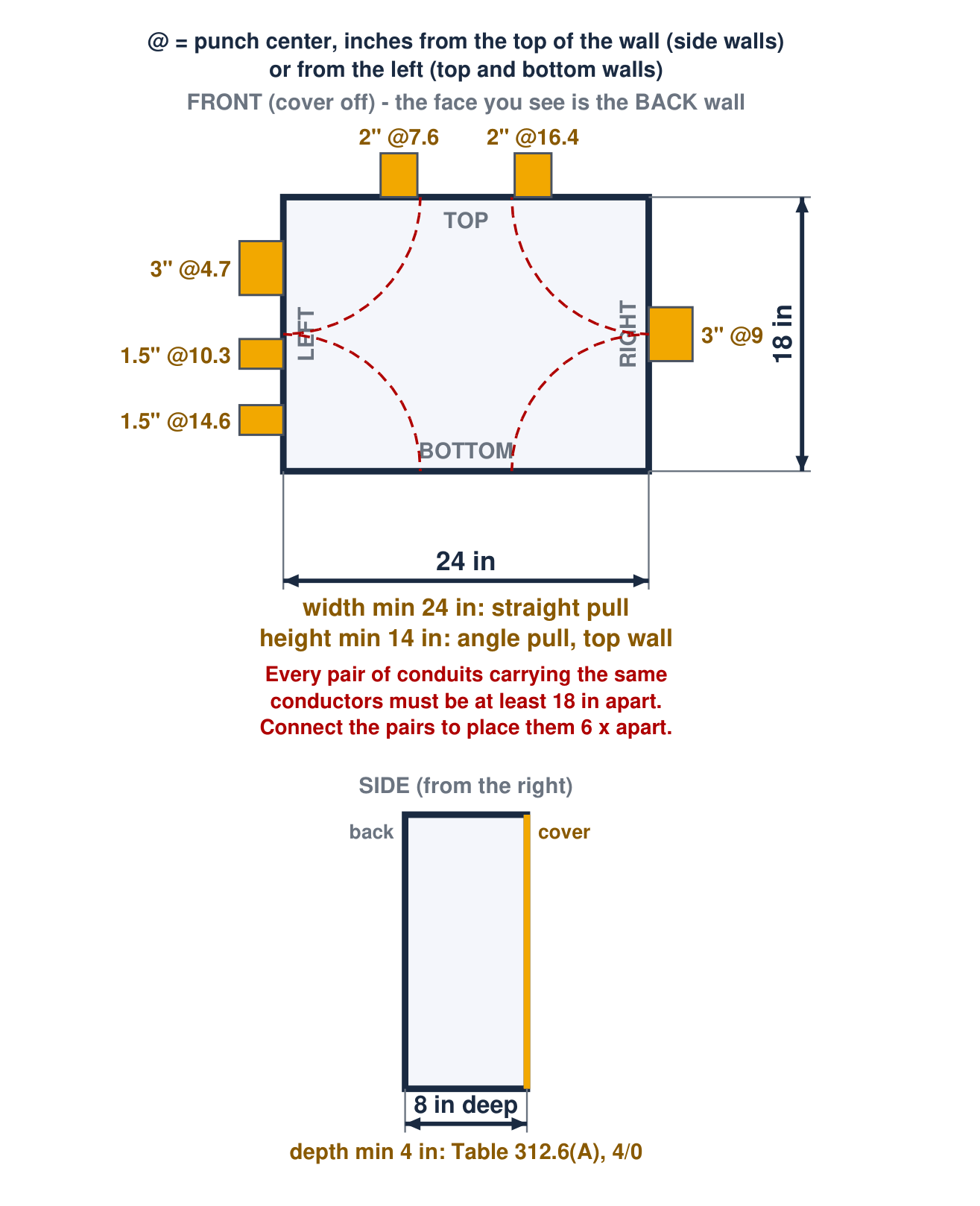
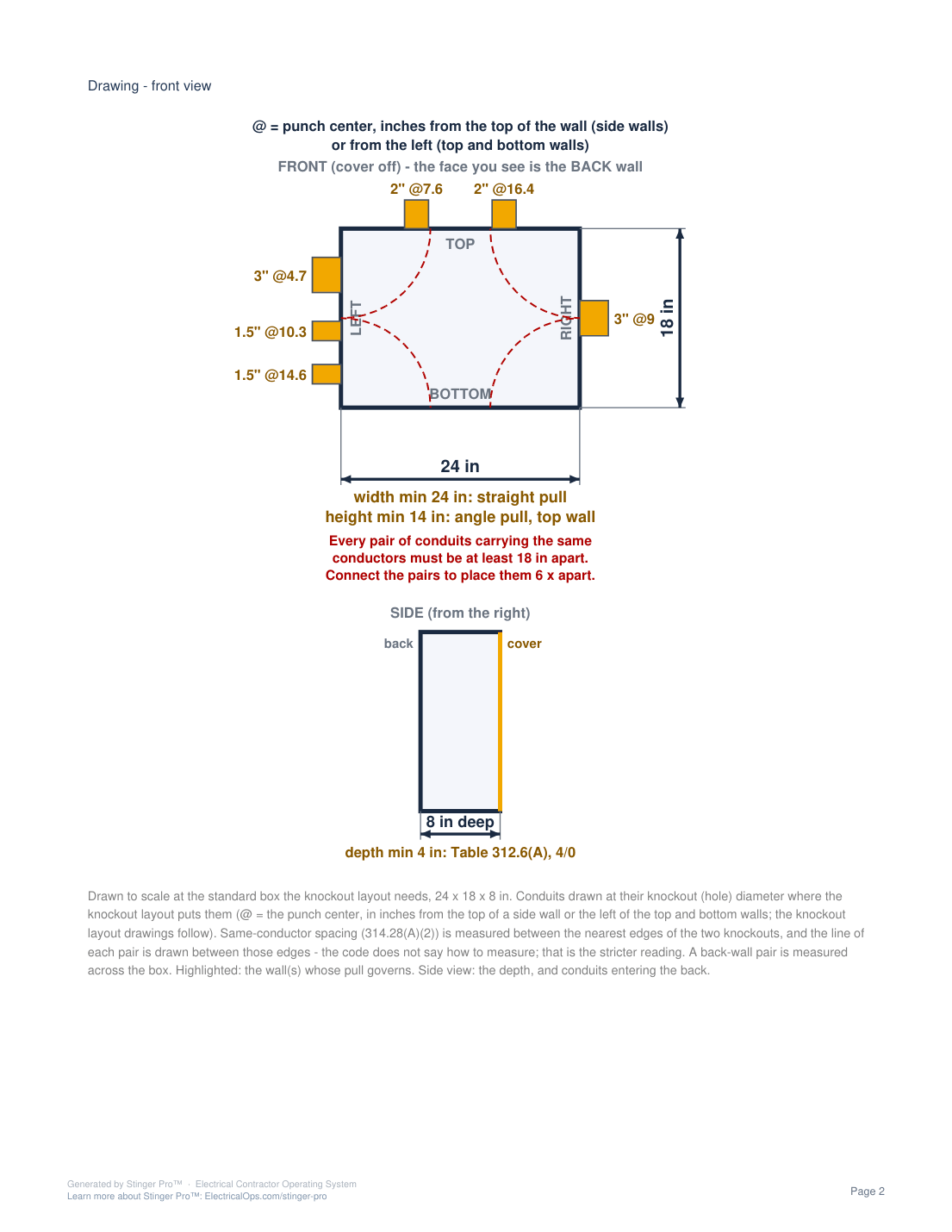
Drawing the program wrote: The phone app's example: 24 x 18 x 8 in. Width 24 in from the straight pull, height 14 in minimum from the angle pull off the top wall, depth 4 in minimum from Table 312.6(A) for 4/0; the box is drawn 8 in deep because the knockouts need it.
The phone app's example: 24 x 18 x 8 in. Width 24 in from the straight pull, height 14 in minimum from the angle pull off the top wall, depth 4 in minimum from Table 312.6(A) for 4/0; the box is drawn 8 in deep because the knockouts need it.

A straight pull

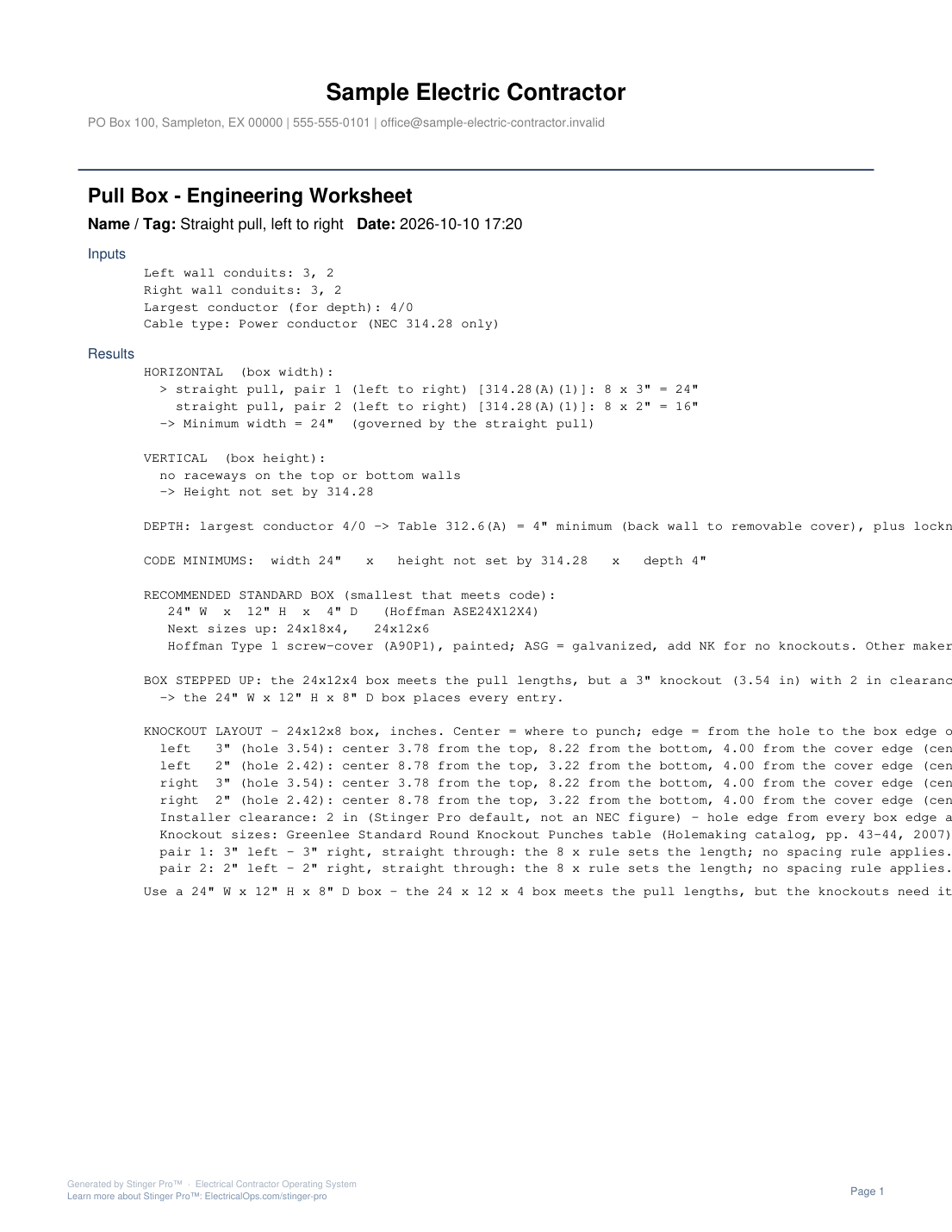
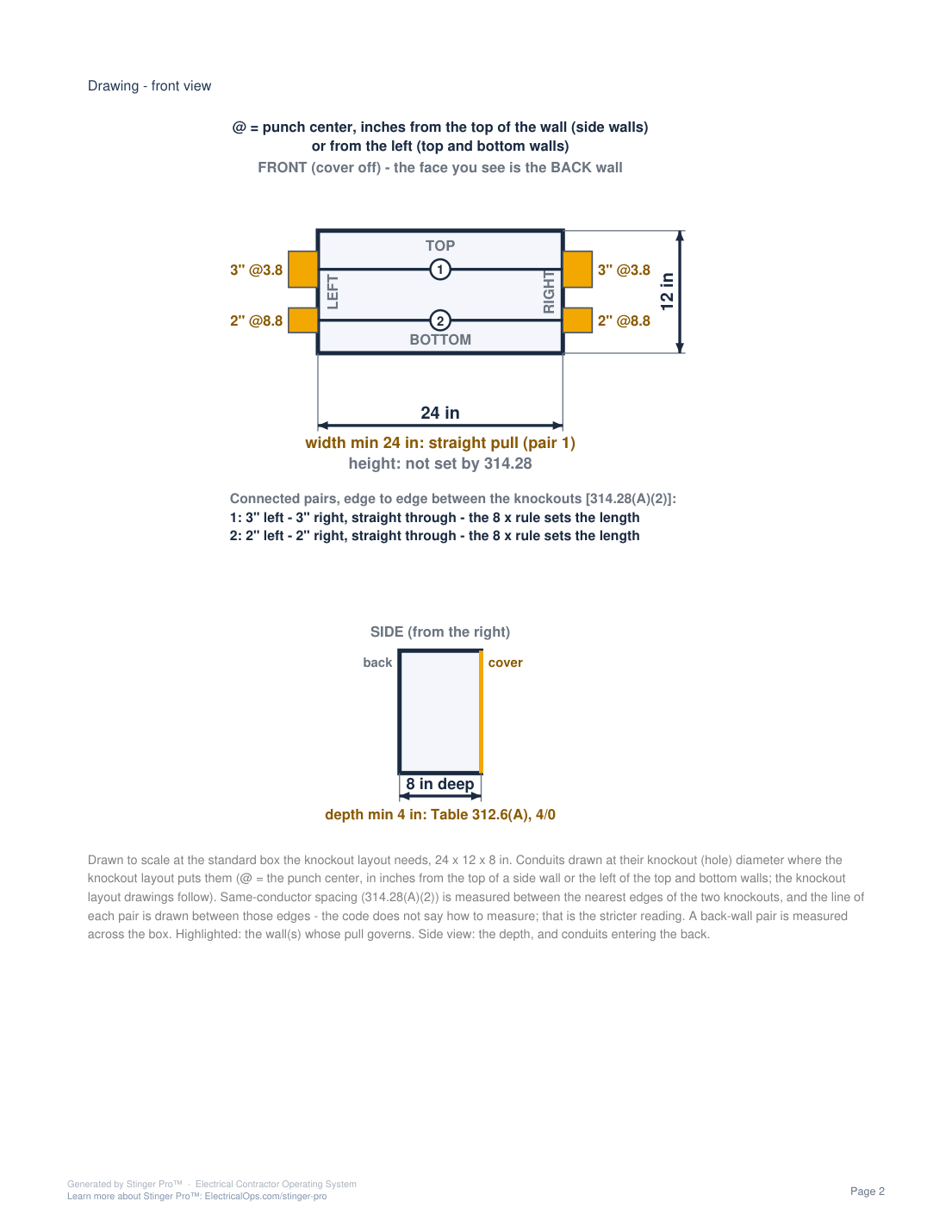
A 3 in and a 2 in conduit on the left wall, each running straight through to the right. The straight pull governs: 8 x 3 in = 24 in wide; no conduits on the top or bottom, so 314.28 does not set the height. The 24 x 12 x 4 in box meets the pull lengths, and the 3 in knockout with its clearance takes it to 8 in deep.
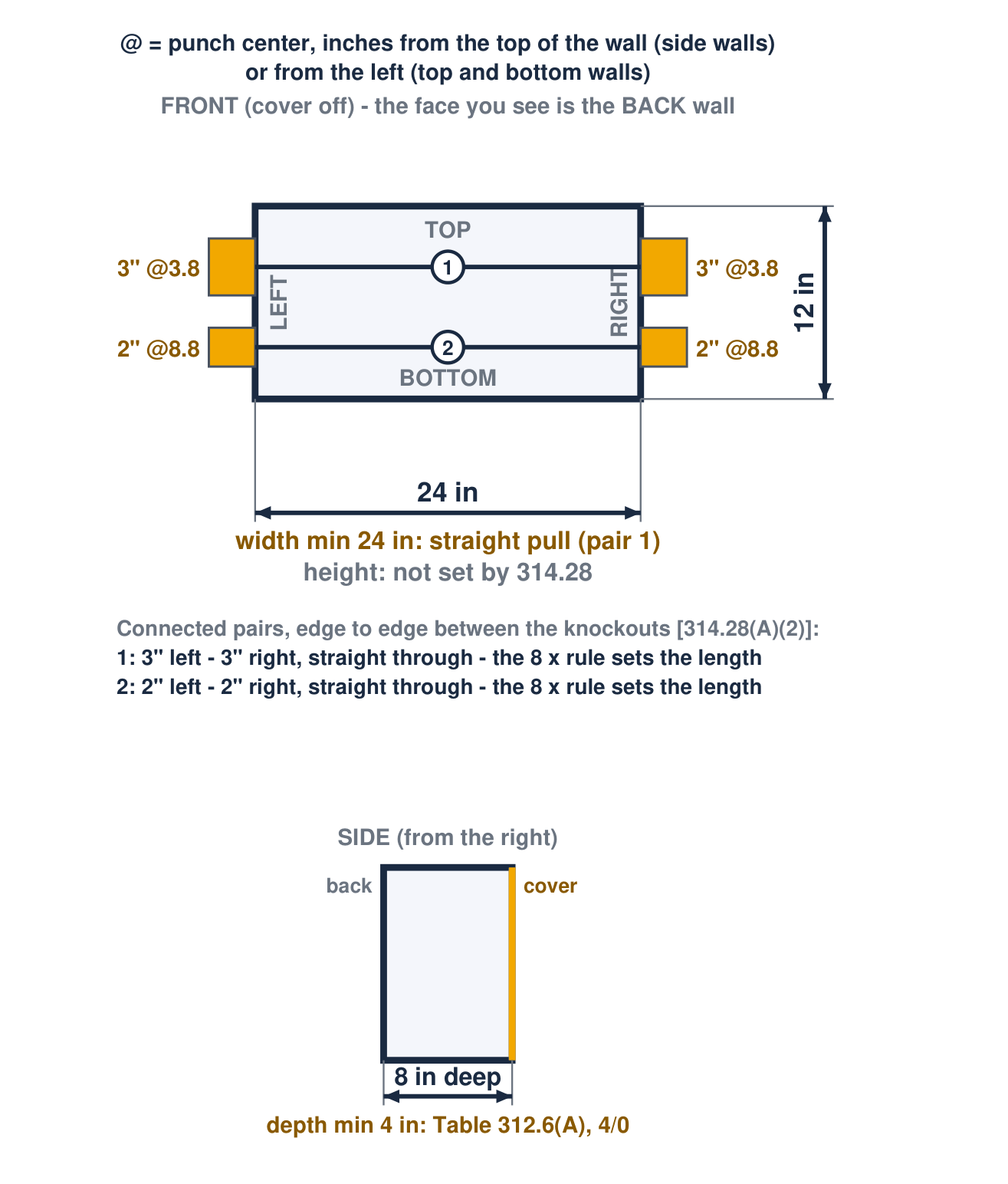
Drawing the program wrote: Front and side view, 24 x 12 x 8 in: the two pairs drawn straight through, 3 in and 2 in, both at 3.8 and 8.8 in from the top.
Front and side view, 24 x 12 x 8 in: the two pairs drawn straight through, 3 in and 2 in, both at 3.8 and 8.8 in from the top.
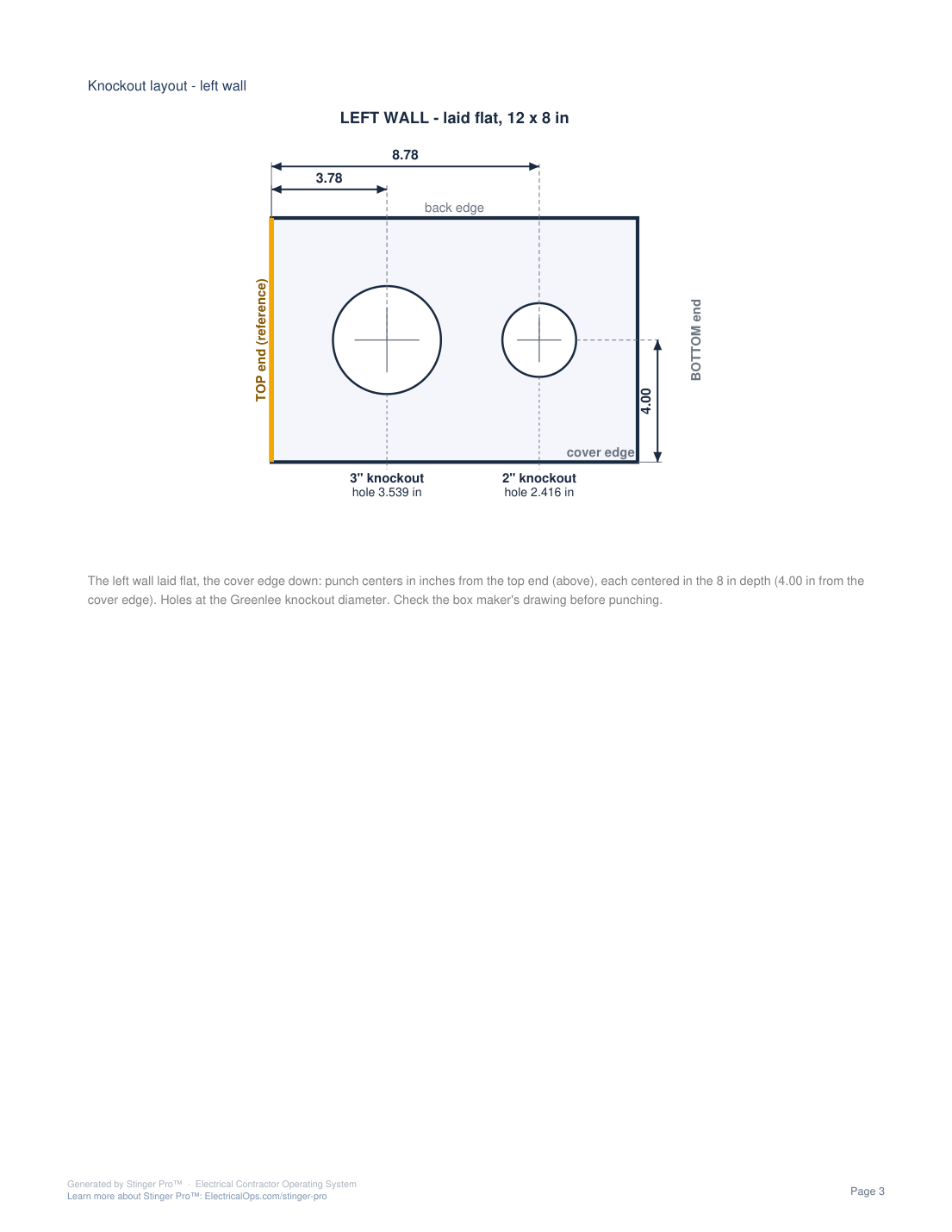
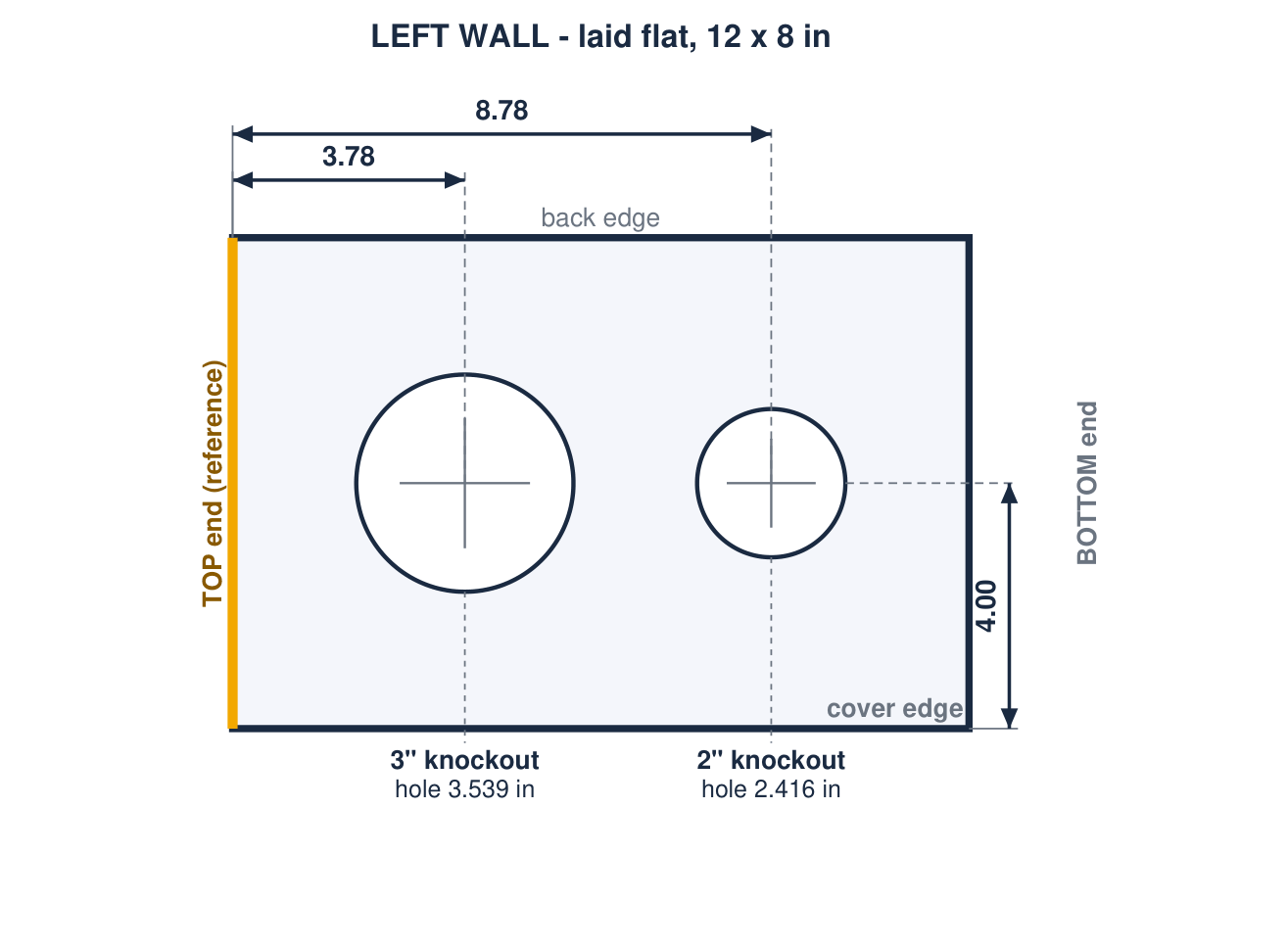
Drawing the program wrote: The left wall laid flat, 12 x 8 in: punch centers 3.78 and 8.78 in from the top end, 4.00 in from the cover edge.
The left wall laid flat, 12 x 8 in: punch centers 3.78 and 8.78 in from the top end, 4.00 in from the cover edge.
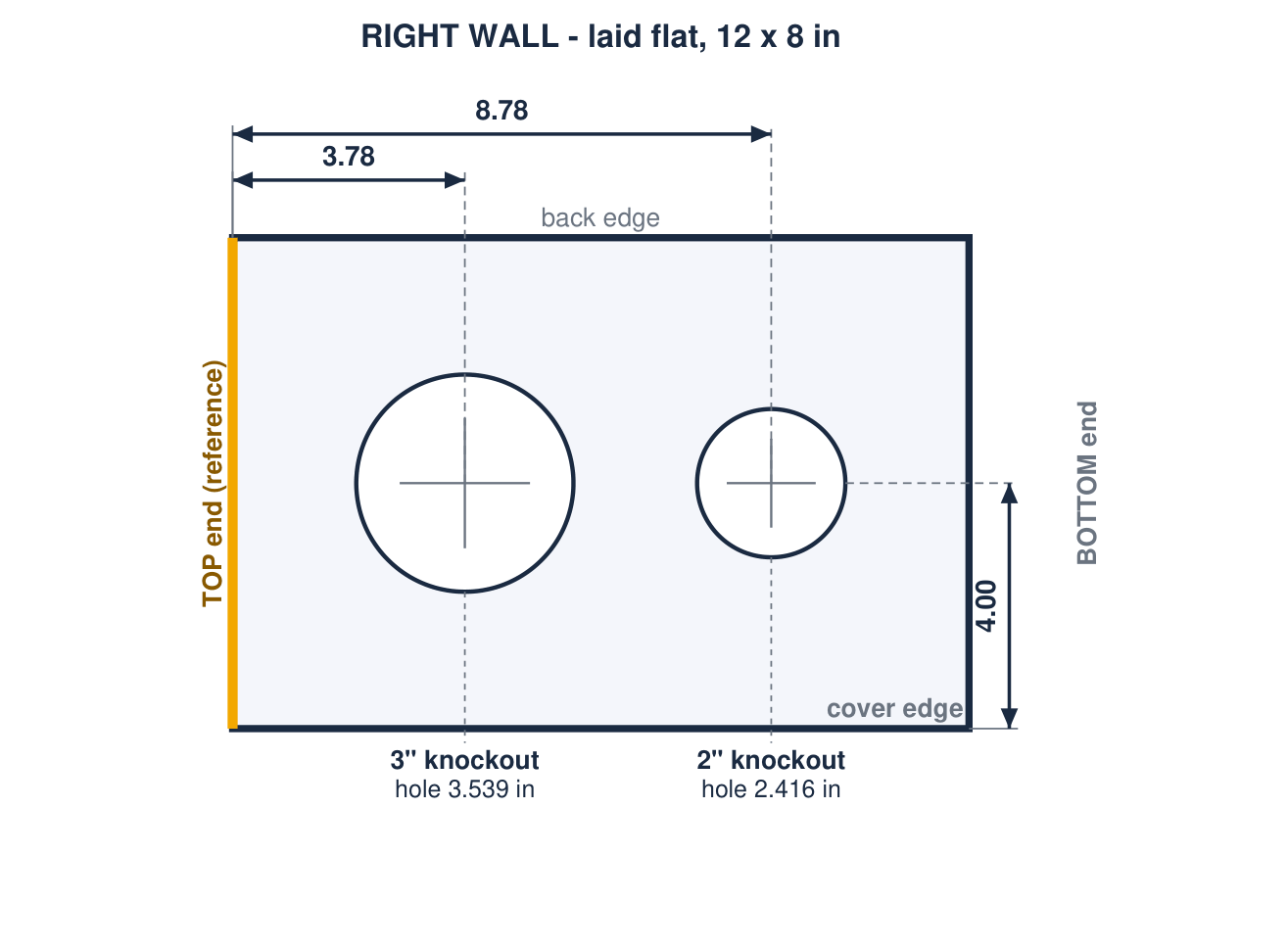
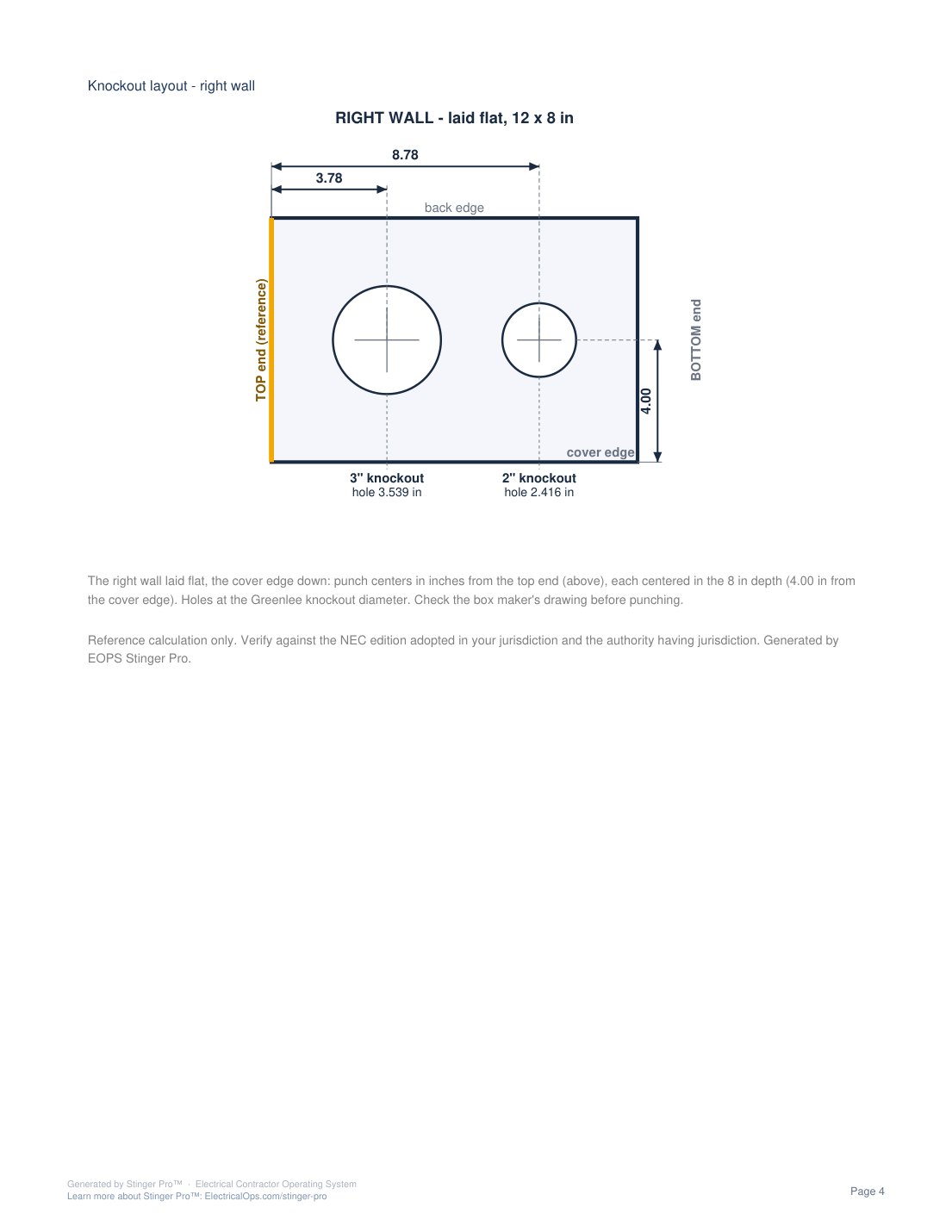
Drawing the program wrote: The right wall laid flat: the same 3.78 and 8.78 in, so each pair lines up across the box.
The right wall laid flat: the same 3.78 and 8.78 in, so each pair lines up across the box.
Report page the program wrote: Page 1 of 4
Page 1 of 4
Report page the program wrote: Page 2 of 4
Page 2 of 4
Report page the program wrote: Page 3 of 4
Page 3 of 4
Report page the program wrote: Page 4 of 4
Page 4 of 4

The work, the front and side view, and the left and right walls laid flat.

An angle pull

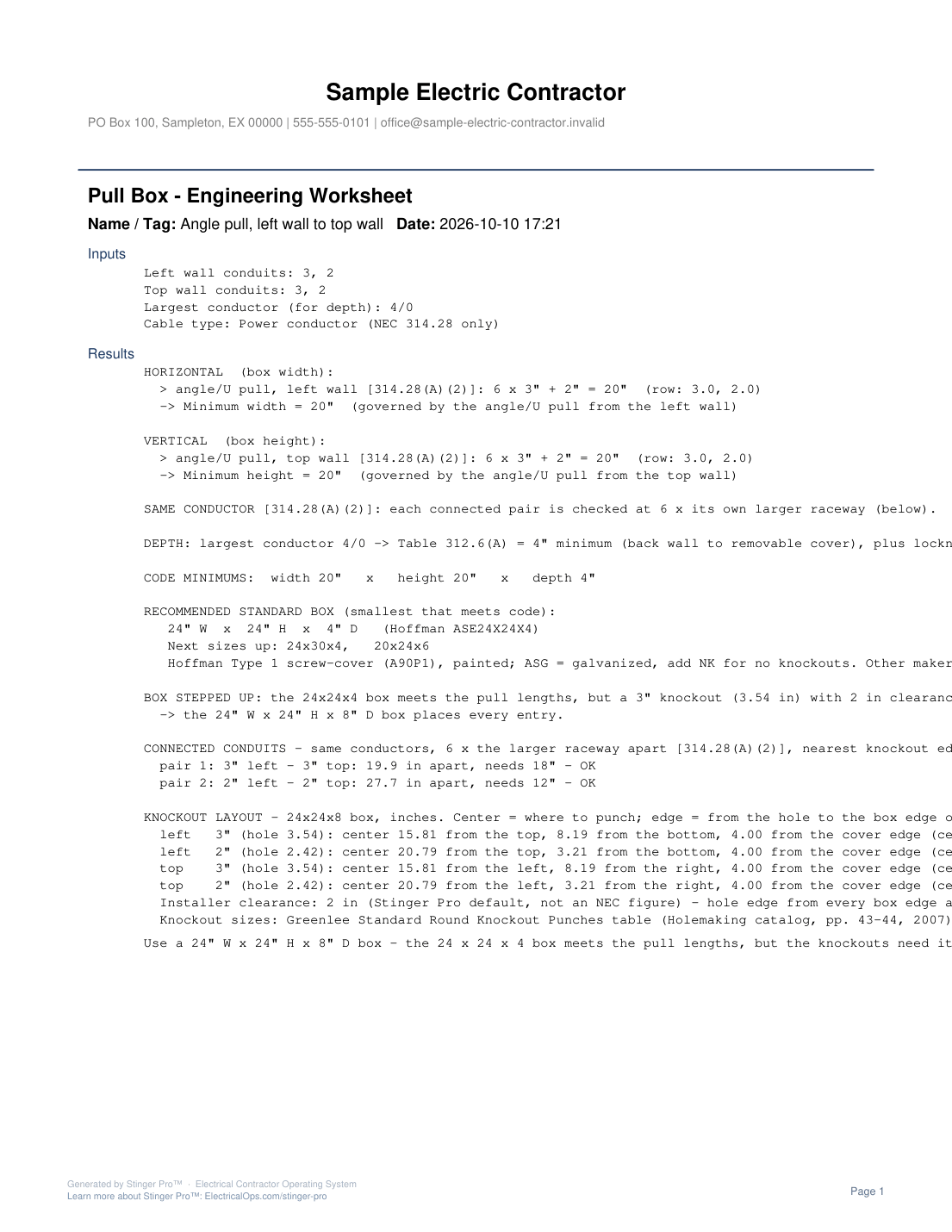
A 3 in and a 2 in conduit on the left wall turning up through the top wall. The 6x rule governs both ways: 6 x 3 in + 2 in = 20 in wide and 20 in high, so the standard box is 24 x 24 in, stepped from 4 to 8 in deep for the knockouts. Each connected pair is checked at 6 x its own raceway: 19.9 in apart against 18 in, and 27.7 in against 12 in.
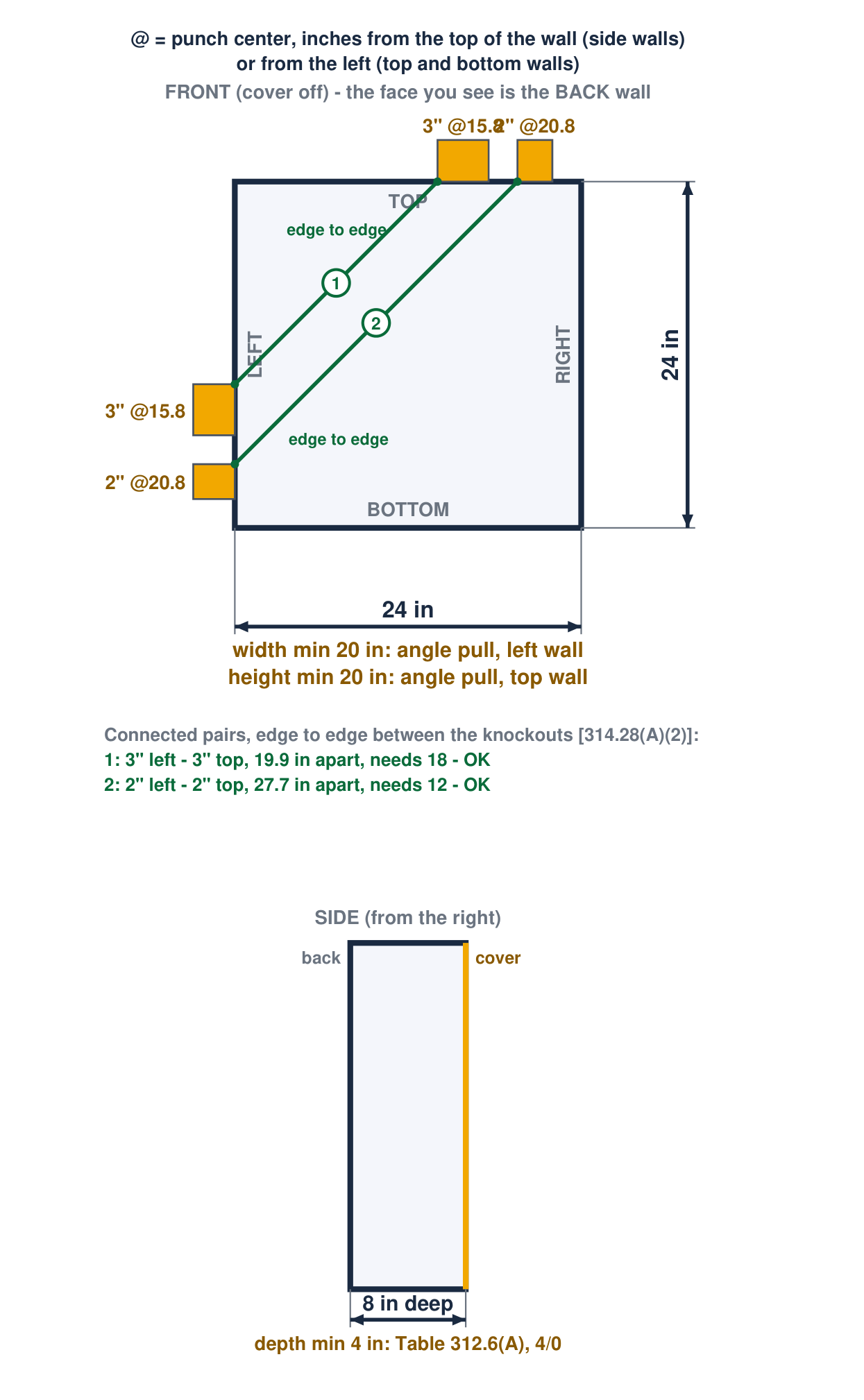
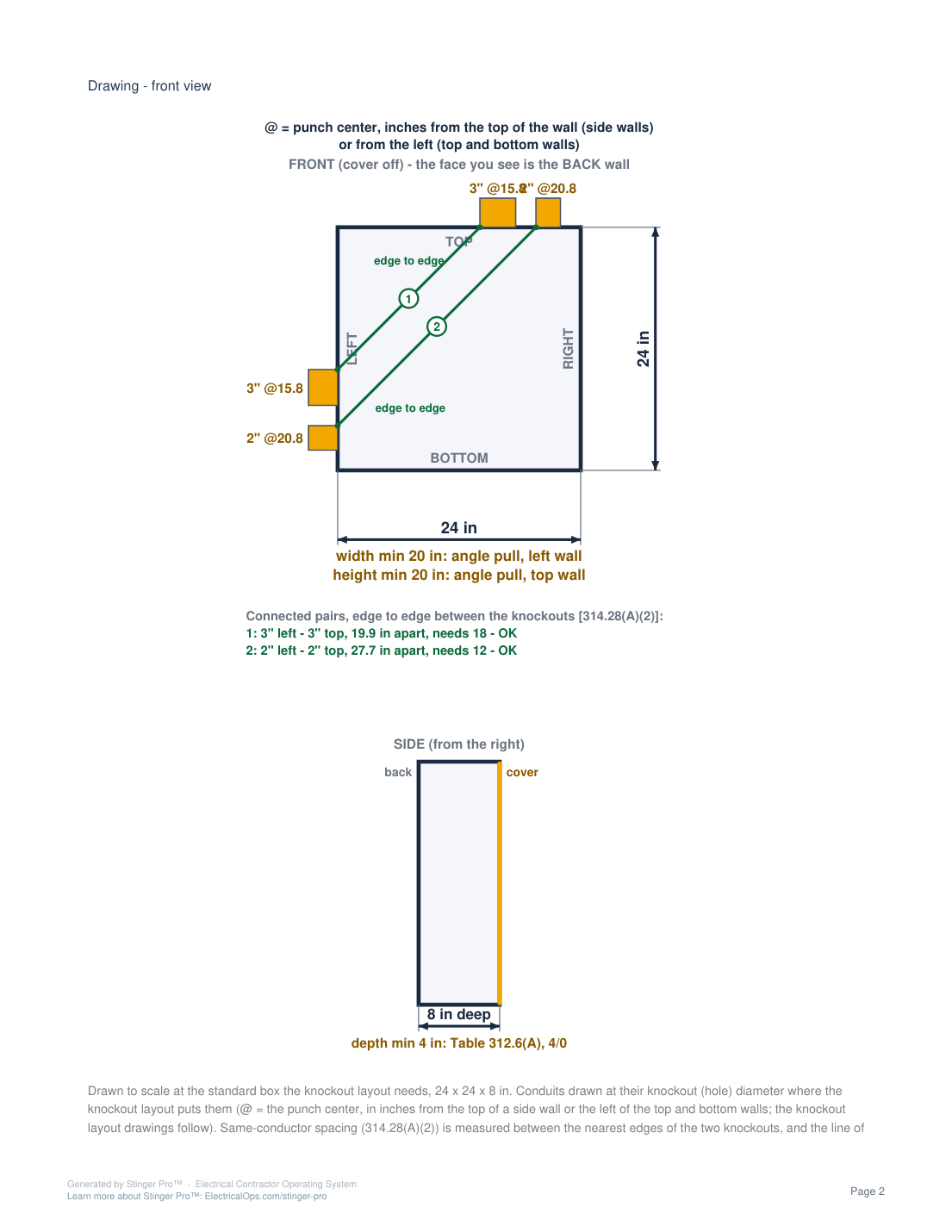
Drawing the program wrote: Front and side view, 24 x 24 x 8 in, with each pair drawn edge to edge between its knockouts: pair 1, 3 in, 19.9 in apart; pair 2, 2 in, 27.7 in apart.
Front and side view, 24 x 24 x 8 in, with each pair drawn edge to edge between its knockouts: pair 1, 3 in, 19.9 in apart; pair 2, 2 in, 27.7 in apart.
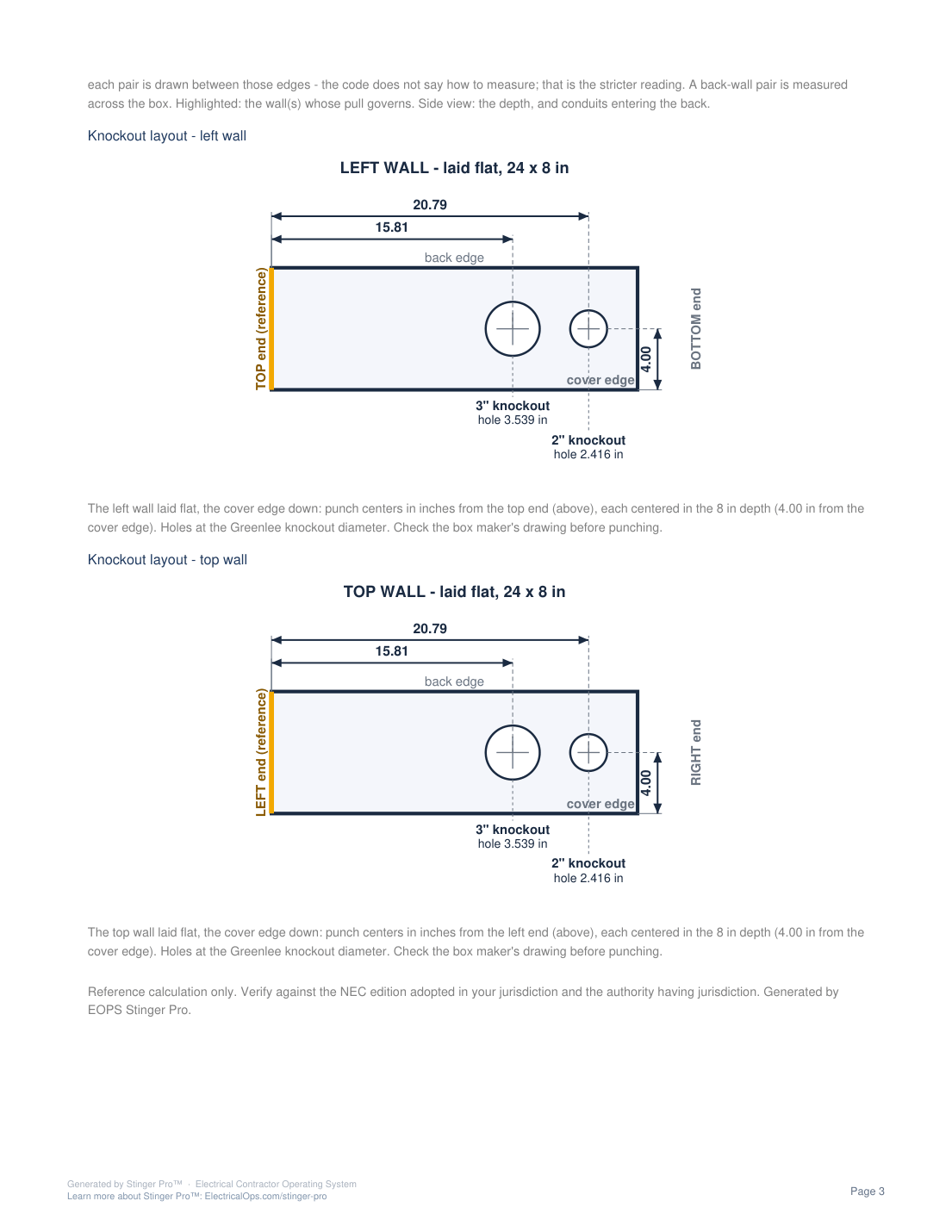
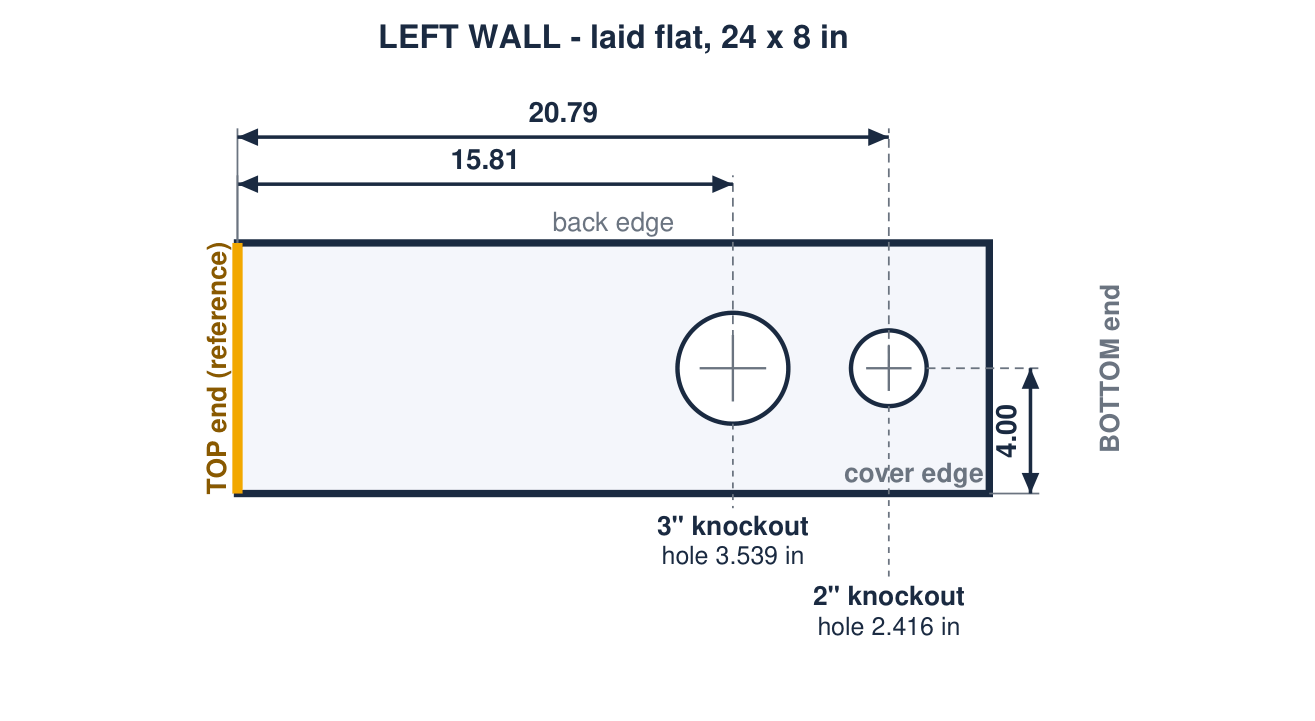
Drawing the program wrote: The left wall laid flat, 24 x 8 in: punch centers 15.81 and 20.79 in from the top end.
The left wall laid flat, 24 x 8 in: punch centers 15.81 and 20.79 in from the top end.
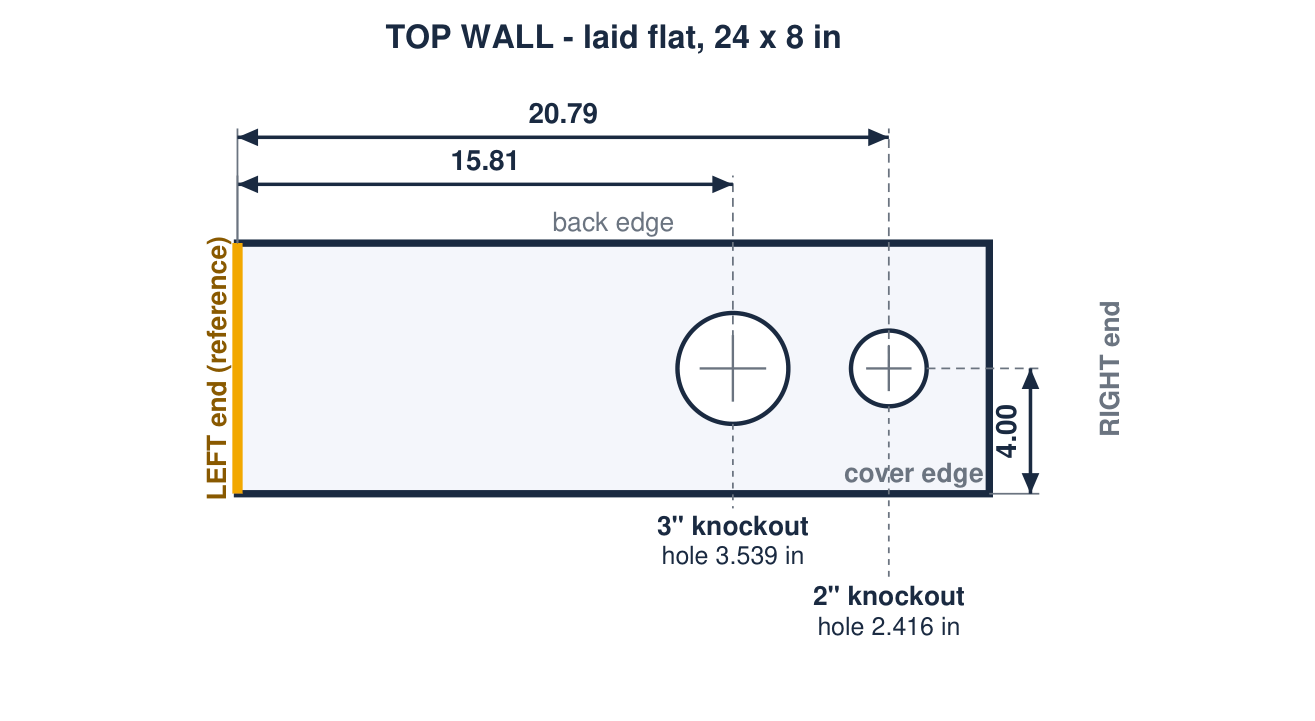
Drawing the program wrote: The top wall laid flat: 15.81 and 20.79 in from the left end, 4.00 in from the cover edge.
The top wall laid flat: 15.81 and 20.79 in from the left end, 4.00 in from the cover edge.
Report page the program wrote: Page 1 of 3
Page 1 of 3
Report page the program wrote: Page 2 of 3
Page 2 of 3
Report page the program wrote: Page 3 of 3
Page 3 of 3

The work with both pair checks, the front and side view, and the left and top walls laid flat.

Conduits entering the back

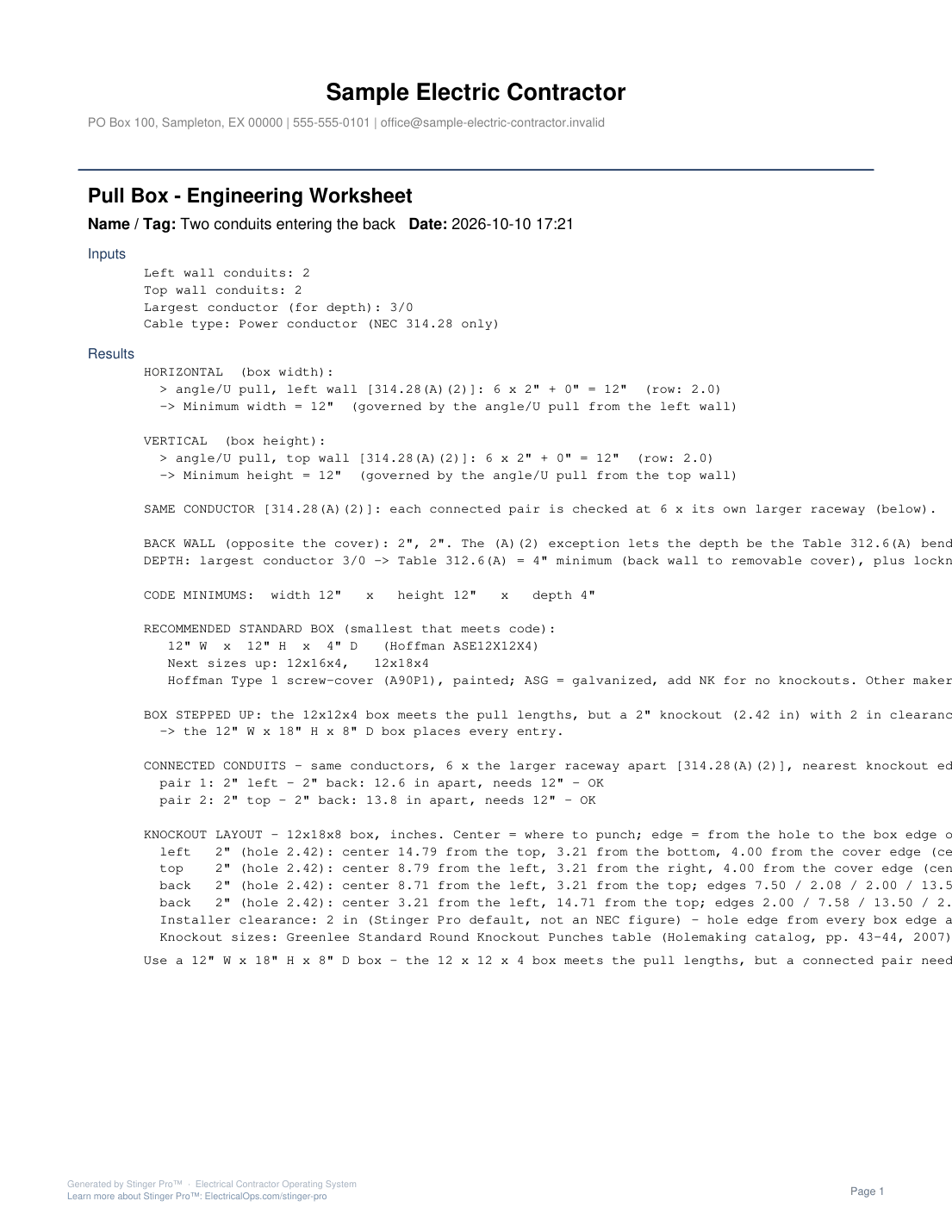
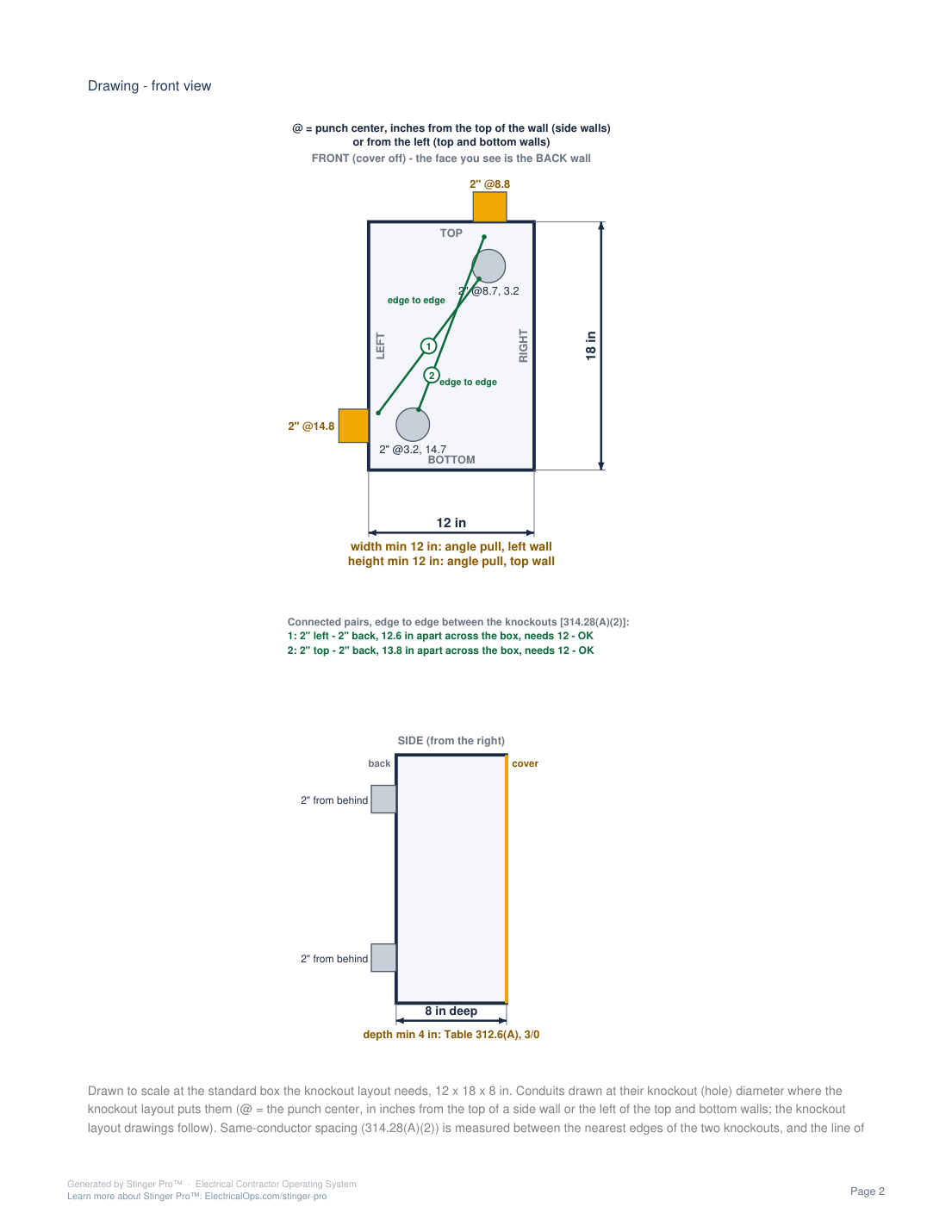
Two 2 in conduits enter the back wall, opposite the cover, one paired with a 2 in on the left wall and one with a 2 in on the top. Width and height come from the angle pulls, 6 x 2 in = 12 in each; the depth is the Table 312.6(A) figure for 3/0, 4 in, instead of 6x. Each pair is measured across the box, 12.6 in and 13.8 in against the 12 in needed, which takes the box to 12 x 18 x 8 in.
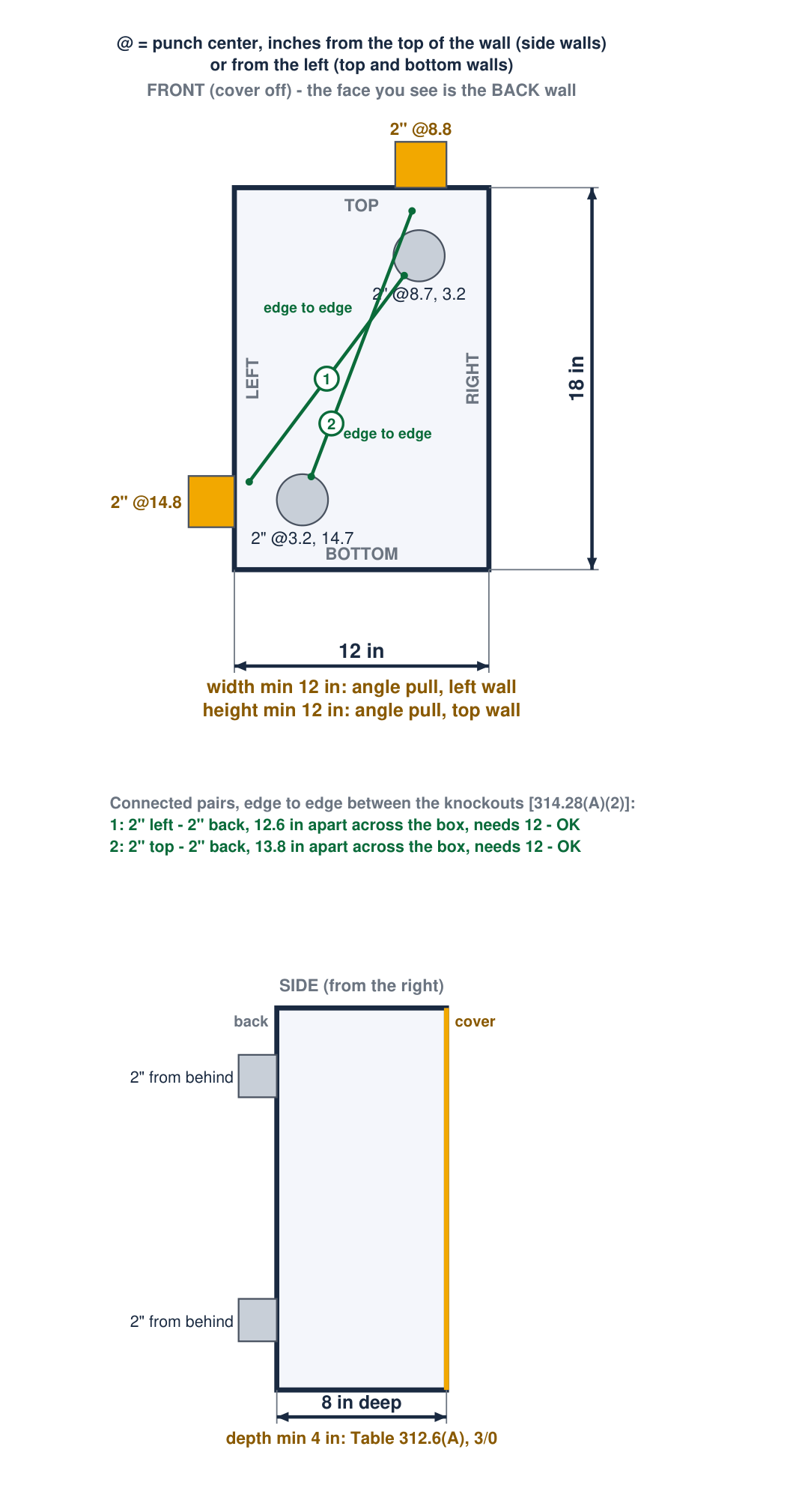
Drawing the program wrote: Front and side view, 12 x 18 x 8 in: the two back-wall conduits drawn as circles on the face, the pairs drawn across the box, and both shown from behind in the side view.
Front and side view, 12 x 18 x 8 in: the two back-wall conduits drawn as circles on the face, the pairs drawn across the box, and both shown from behind in the side view.
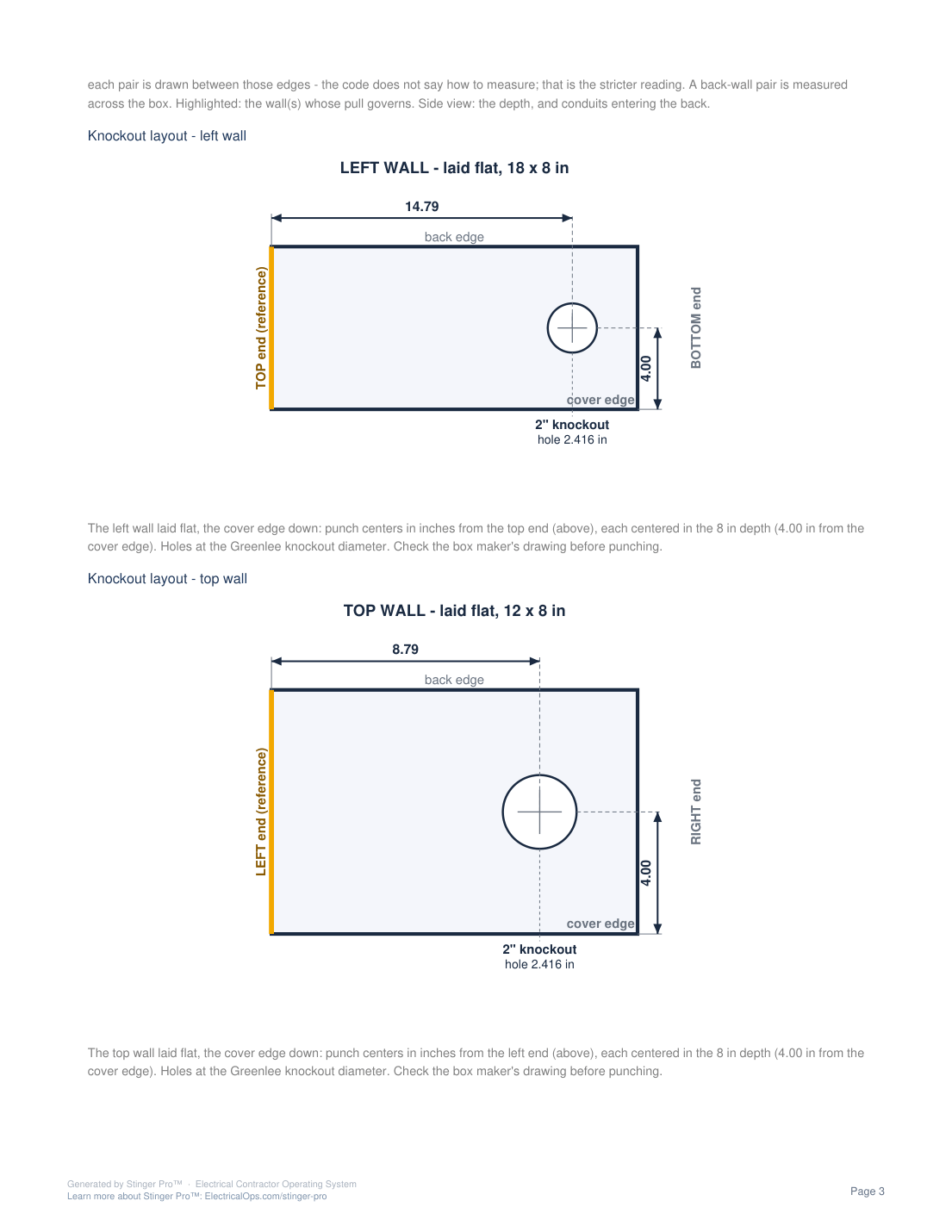
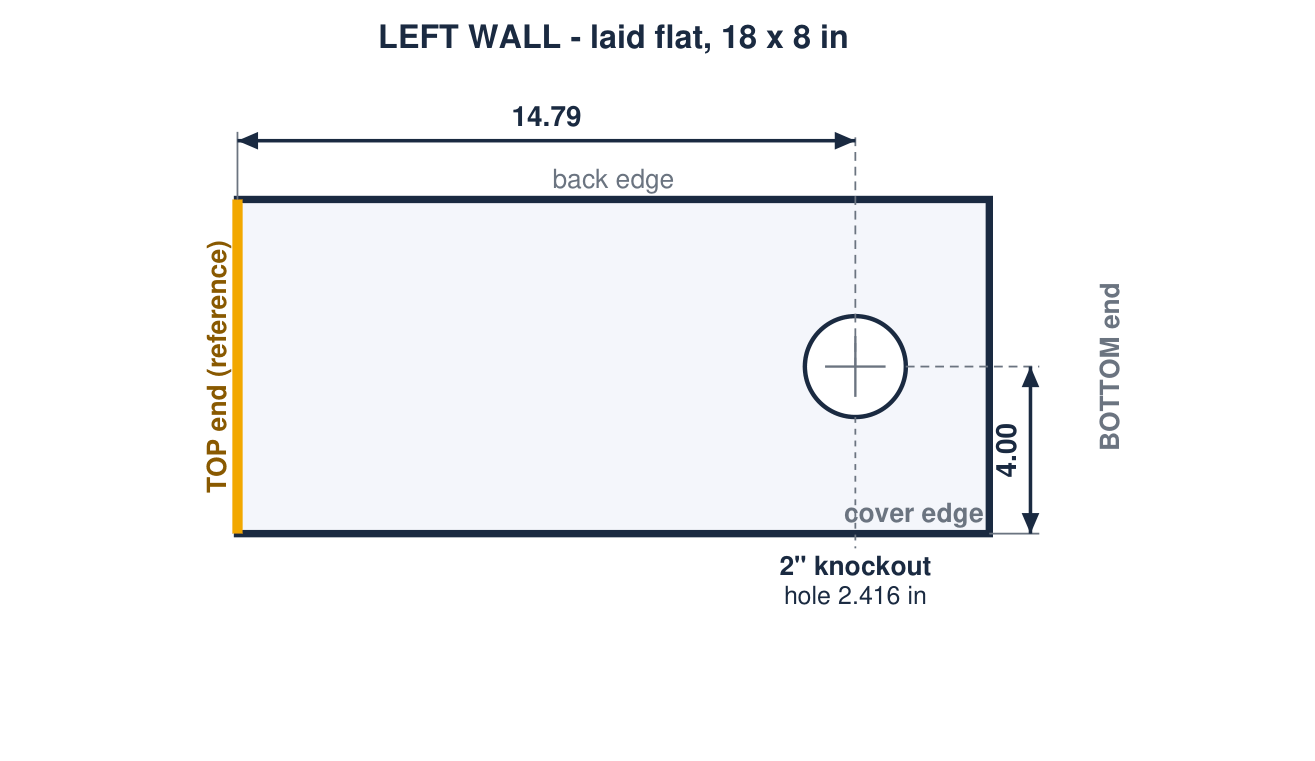
Drawing the program wrote: The left wall laid flat, 18 x 8 in: one punch center 14.79 in from the top end.
The left wall laid flat, 18 x 8 in: one punch center 14.79 in from the top end.
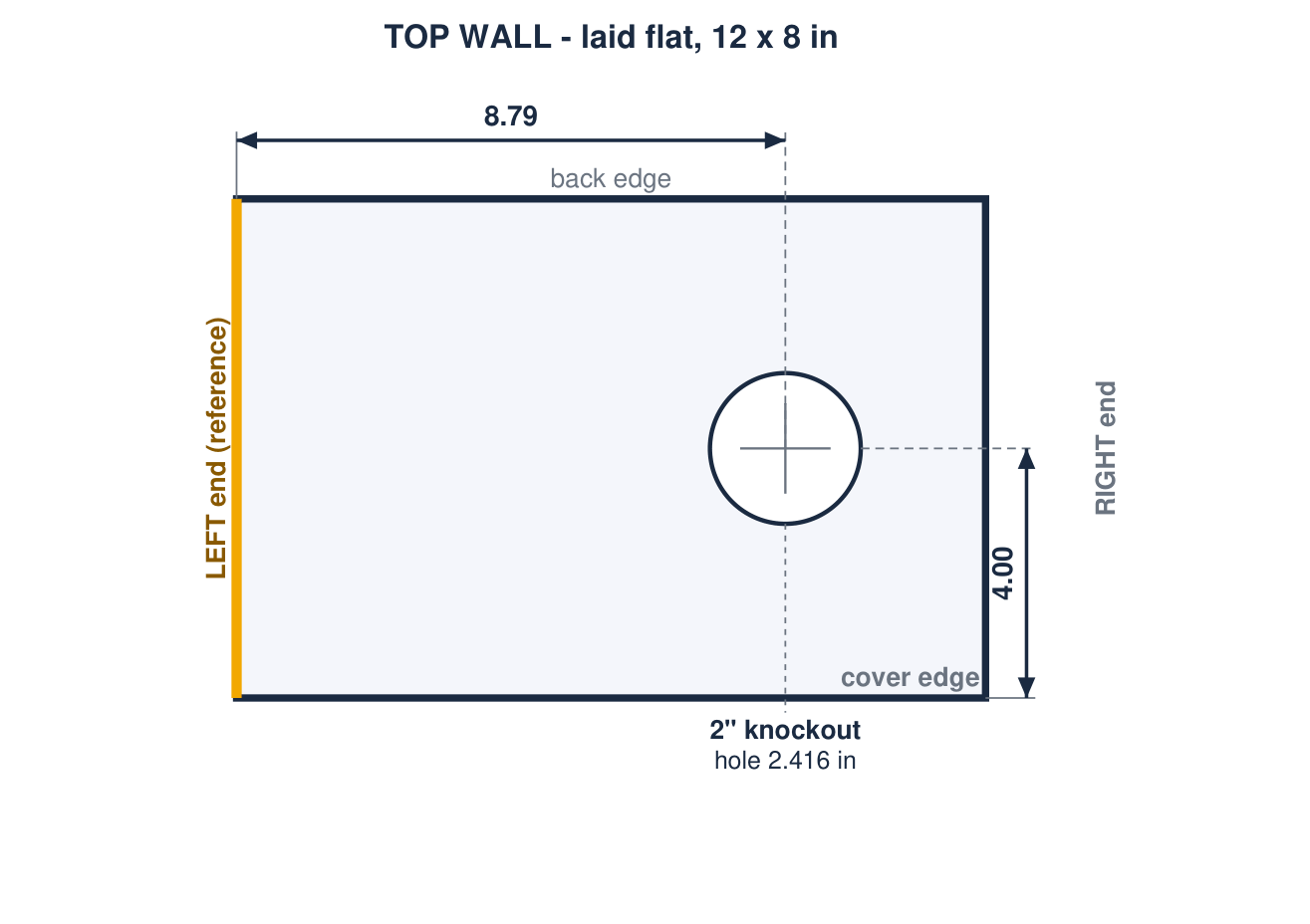
Drawing the program wrote: The top wall laid flat, 12 x 8 in: one punch center 8.79 in from the left end.
The top wall laid flat, 12 x 8 in: one punch center 8.79 in from the left end.
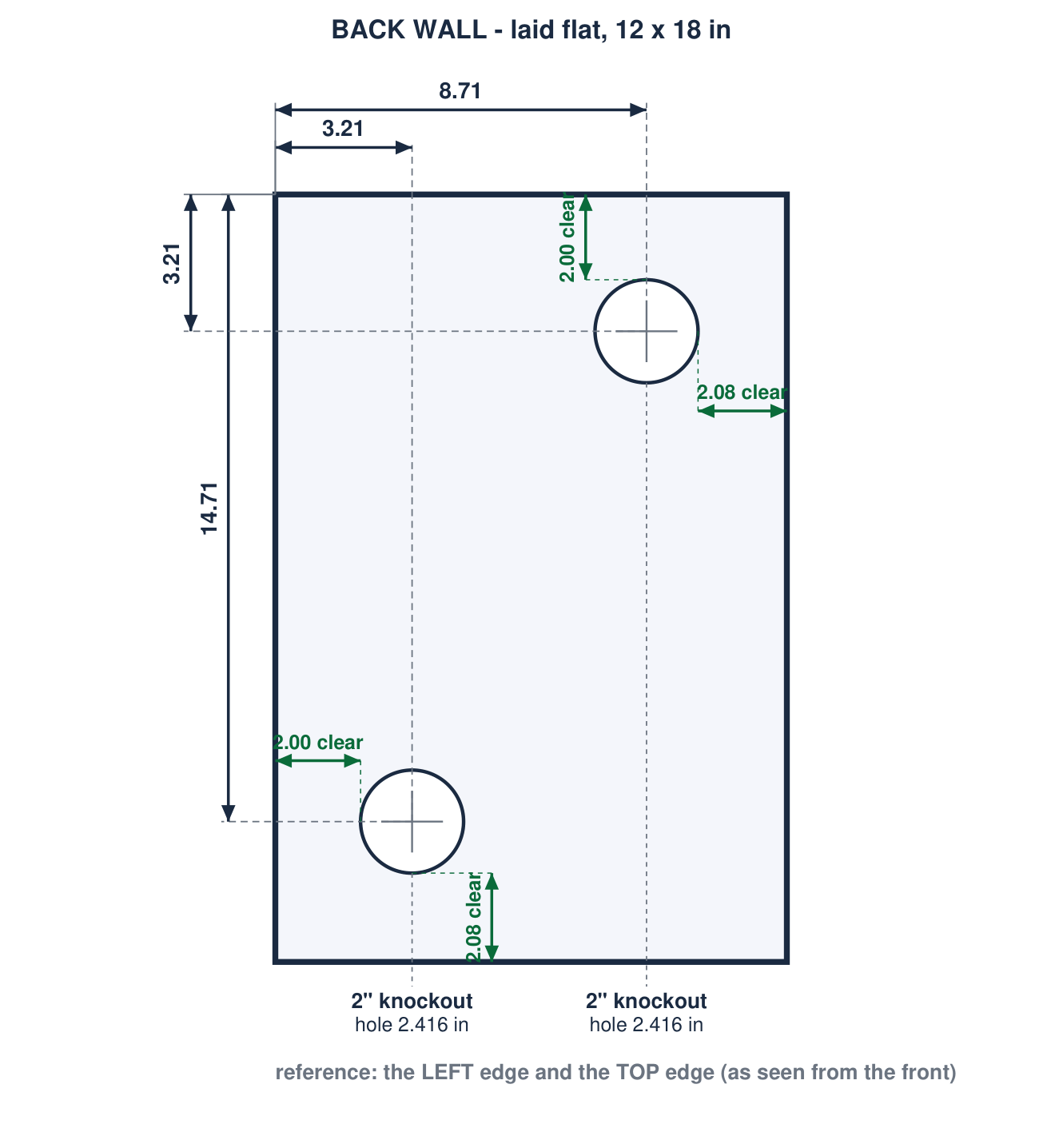
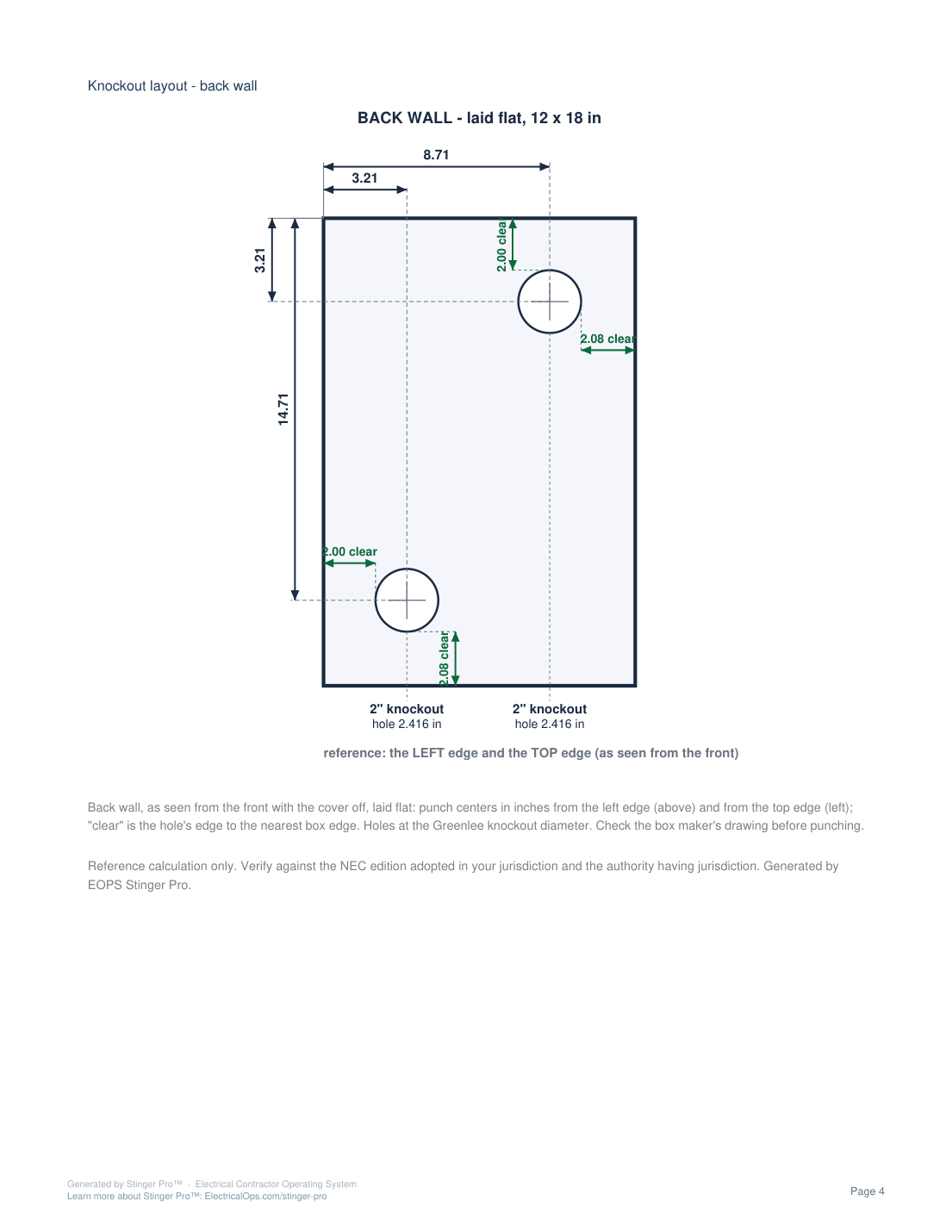
Drawing the program wrote: The back wall laid flat as seen from the front, 12 x 18 in: centers at 8.71, 3.21 and 3.21, 14.71 in from the left and top edges, each hole 2.00 and 2.08 in clear of the nearest edges.
The back wall laid flat as seen from the front, 12 x 18 in: centers at 8.71, 3.21 and 3.21, 14.71 in from the left and top edges, each hole 2.00 and 2.08 in clear of the nearest edges.
Report page the program wrote: Page 1 of 4
Page 1 of 4
Report page the program wrote: Page 2 of 4
Page 2 of 4
Report page the program wrote: Page 3 of 4
Page 3 of 4
Report page the program wrote: Page 4 of 4
Page 4 of 4

The work with the back-wall depth and both pair checks, the front and side view, and the left, top and back walls laid flat.

The report it writes

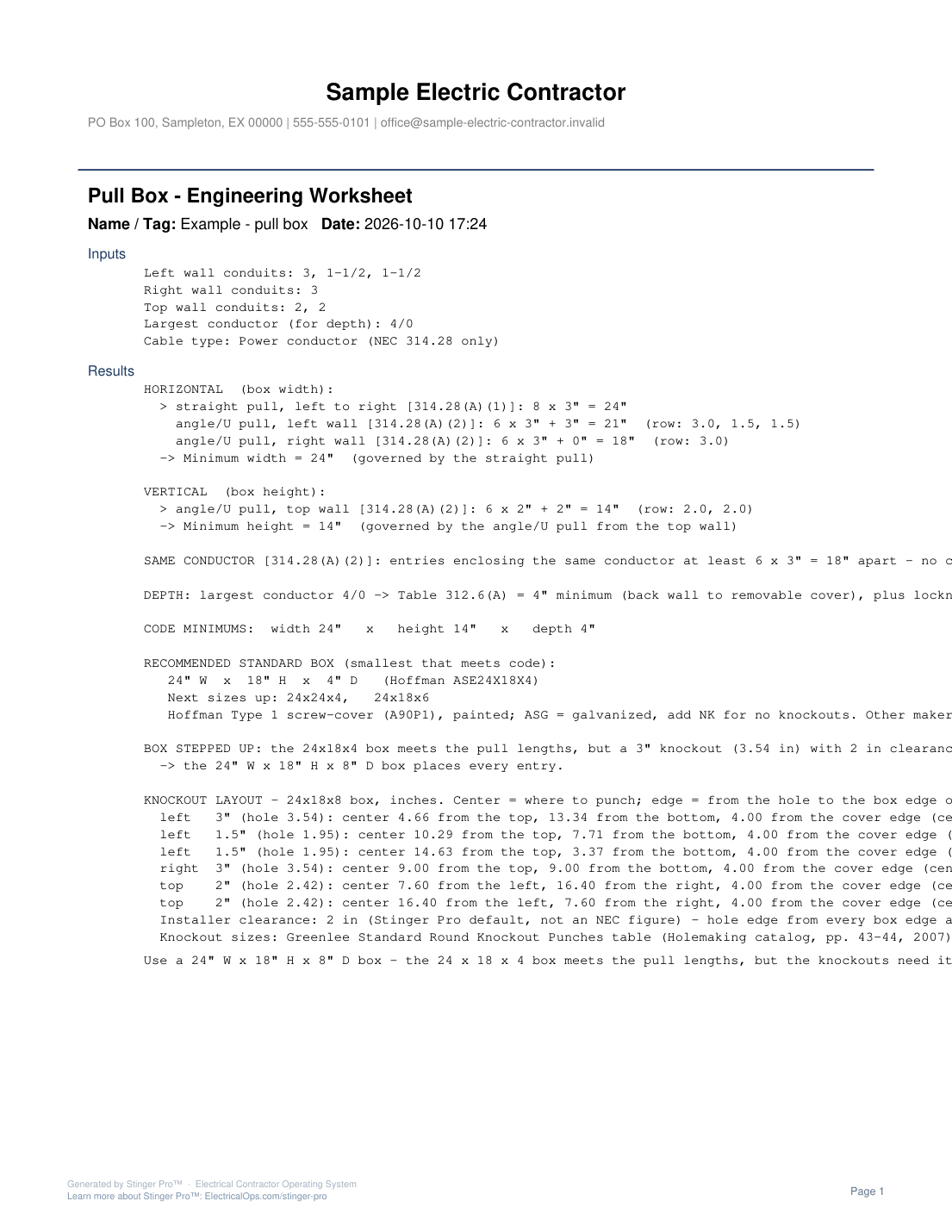
The report the Suite wrote for the phone app's example: four pages.
Report page the program wrote: Page 1 of 4
Page 1 of 4
Report page the program wrote: Page 2 of 4
Page 2 of 4
Report page the program wrote: Page 3 of 4
Page 3 of 4
Report page the program wrote: Page 4 of 4
Page 4 of 4

Page 1 is the work: each pull with its 314.28 rule, the code minimums of 24 x 14 x 4 in, the Hoffman box, and every punch center; then the front and side view and the left, right and top walls laid flat.

The example, step by step

The phone app's example job, Example - pull box, opened with Open phone job… and worked out by the Suite.
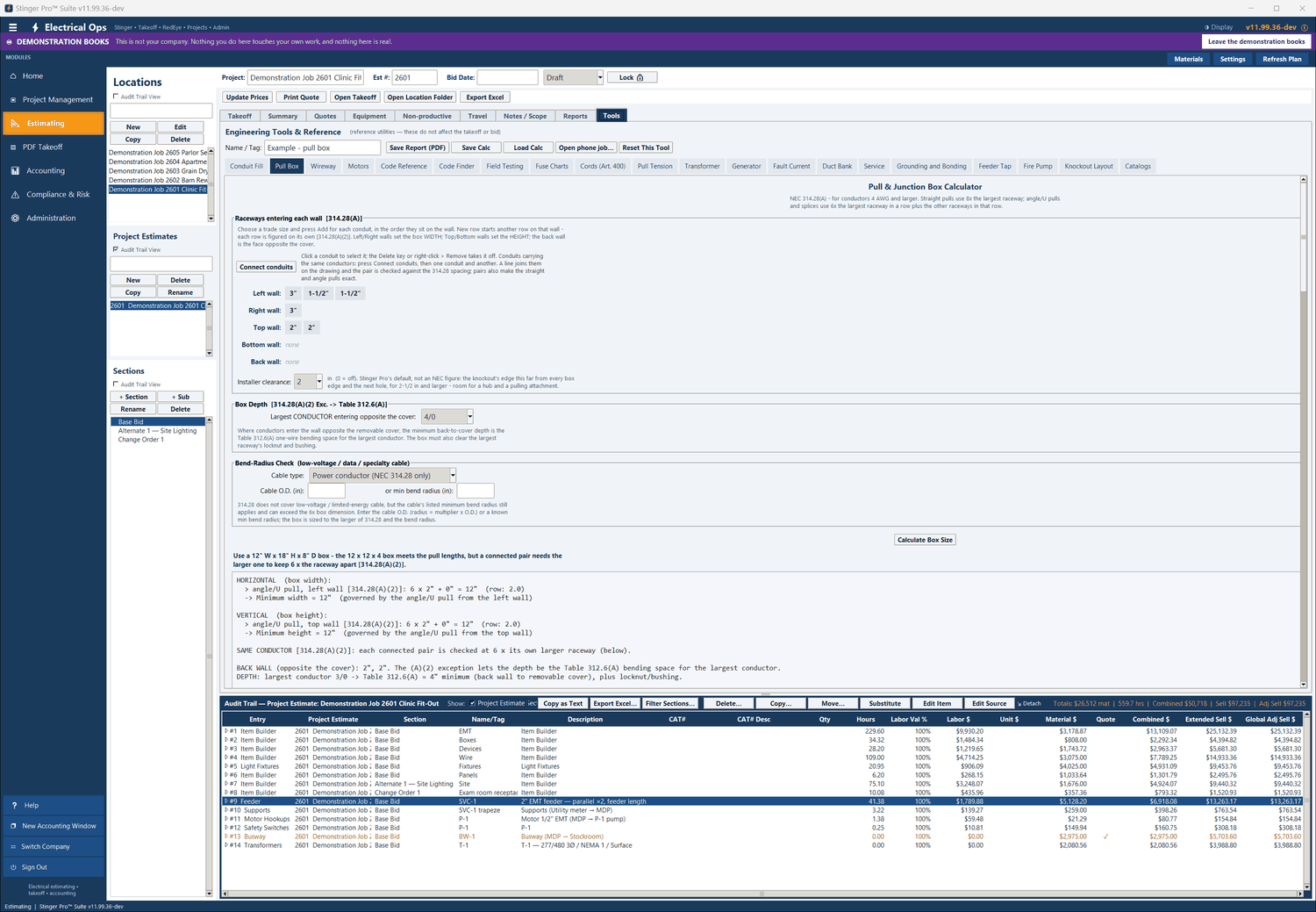
  1. Pull Box in Stinger Pro: The example in, before it is worked out: 3, 1-1/2 and 1-1/2 in on the left wall, 3 in on the right, two 2 in on top, 4/0 the largest conductor.
    STEP 1 OF 6The example in, before it is worked out: 3, 1-1/2 and 1-1/2 in on the left wall, 3 in on the right, two 2 in on top, 4/0 the largest conductor.

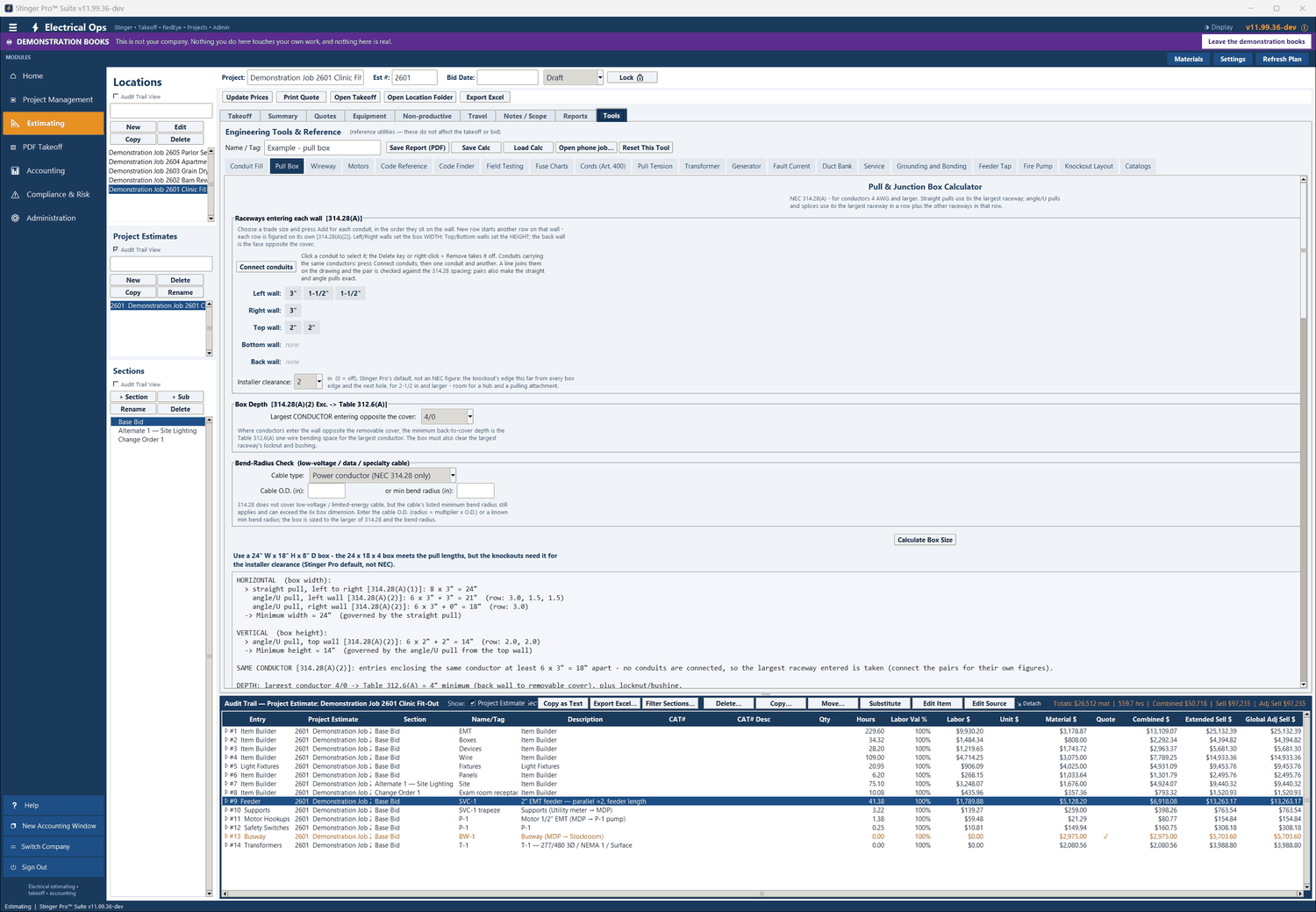
  2. Pull Box in Stinger Pro: Worked out: use a 24 x 18 x 8 in box. Width 24 in from the 8 x 3 in straight pull; height 14 in from the angle pull off the top wall.
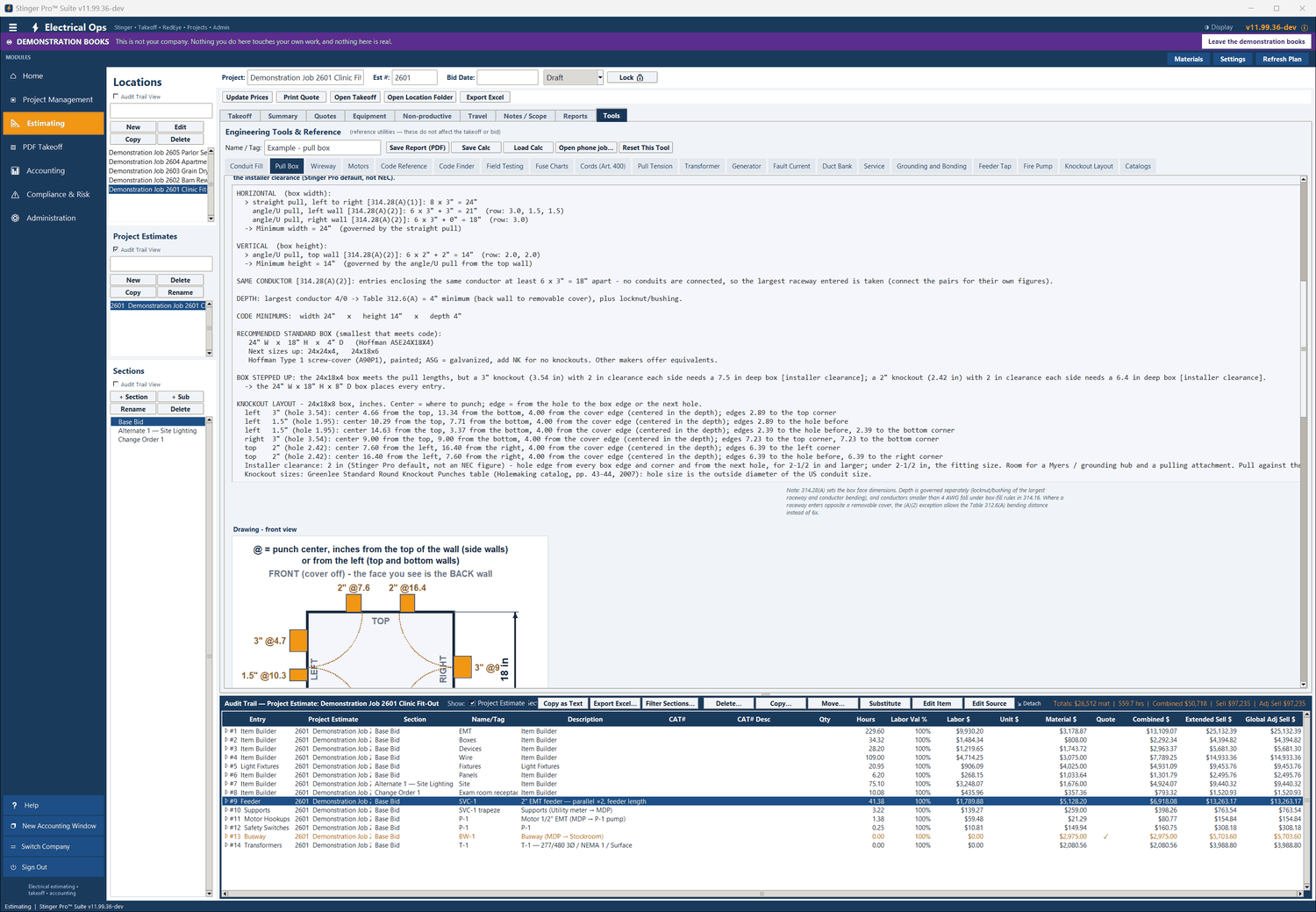
    STEP 2 OF 6Worked out: use a 24 x 18 x 8 in box. Width 24 in from the 8 x 3 in straight pull; height 14 in from the angle pull off the top wall.

  3. Pull Box in Stinger Pro: The code minimums, 24 x 14 x 4 in; the smallest standard box, 24 x 18 x 4 (Hoffman ASE24X18X4), stepped to 8 in deep for the knockouts; and every punch center.
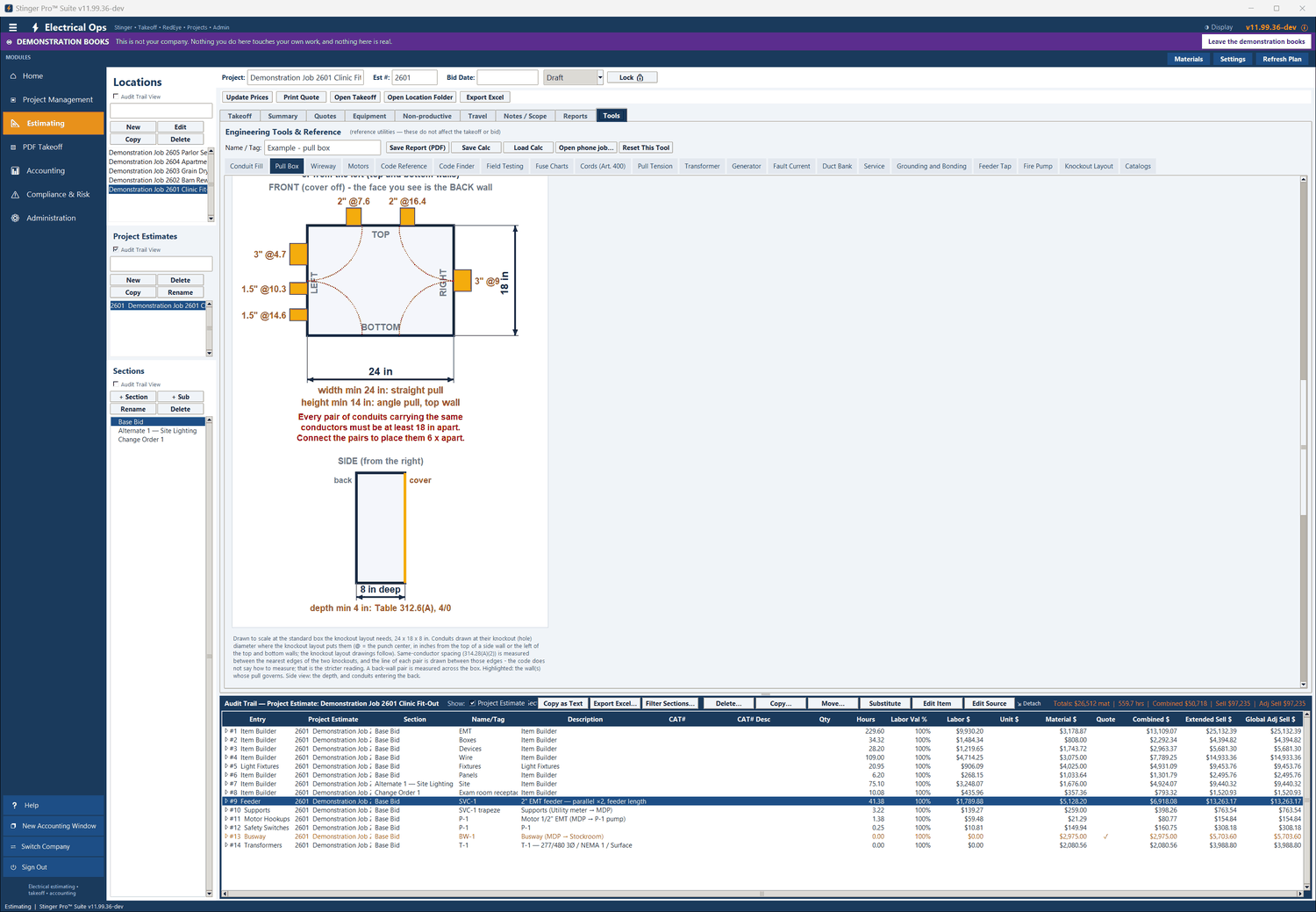
    STEP 3 OF 6The code minimums, 24 x 14 x 4 in; the smallest standard box, 24 x 18 x 4 (Hoffman ASE24X18X4), stepped to 8 in deep for the knockouts; and every punch center.

  4. Pull Box in Stinger Pro: The front view to scale with each knockout where it goes, and the side view: 8 in deep against the 4 in Table 312.6(A) minimum for 4/0.
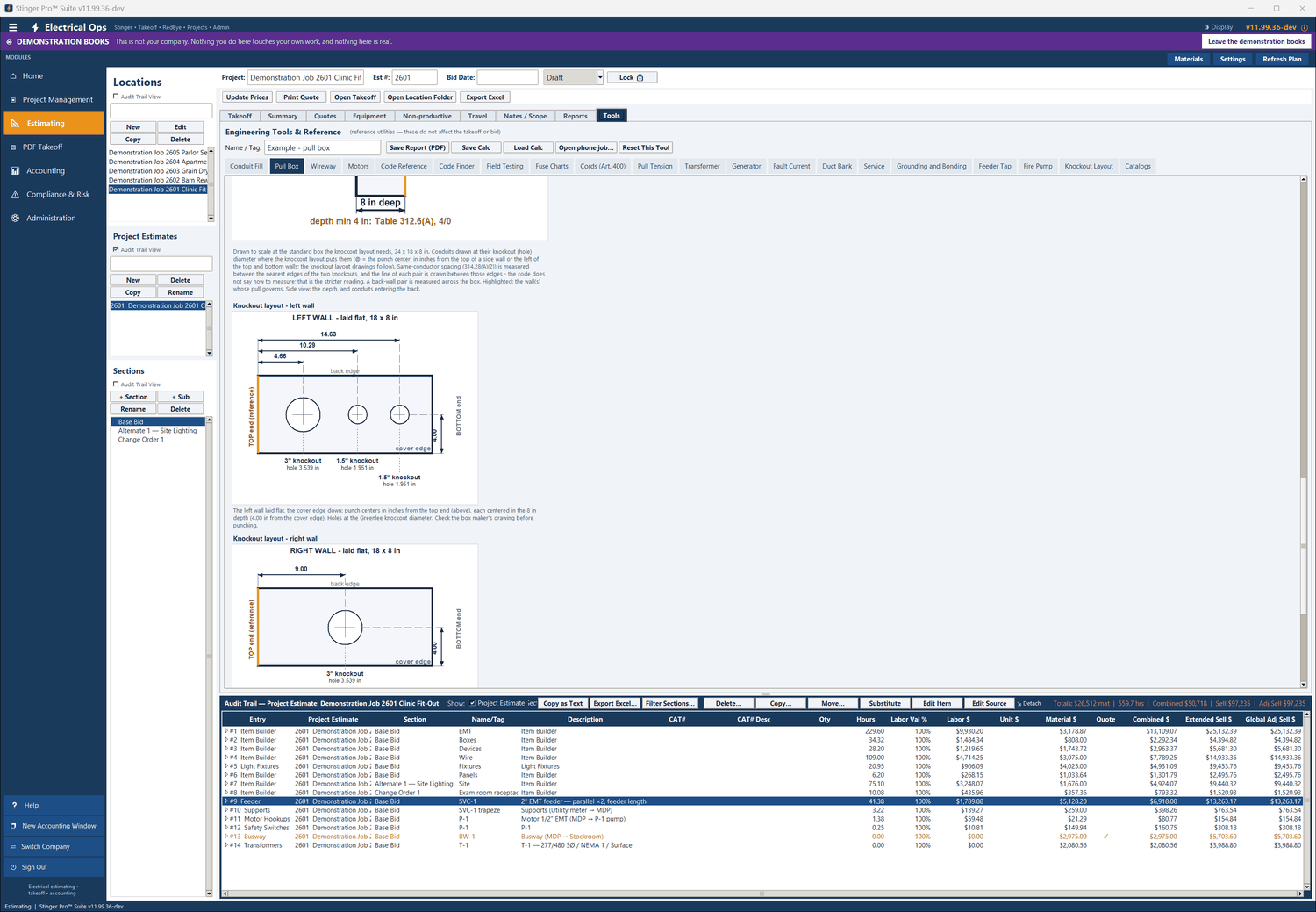
    STEP 4 OF 6The front view to scale with each knockout where it goes, and the side view: 8 in deep against the 4 in Table 312.6(A) minimum for 4/0.

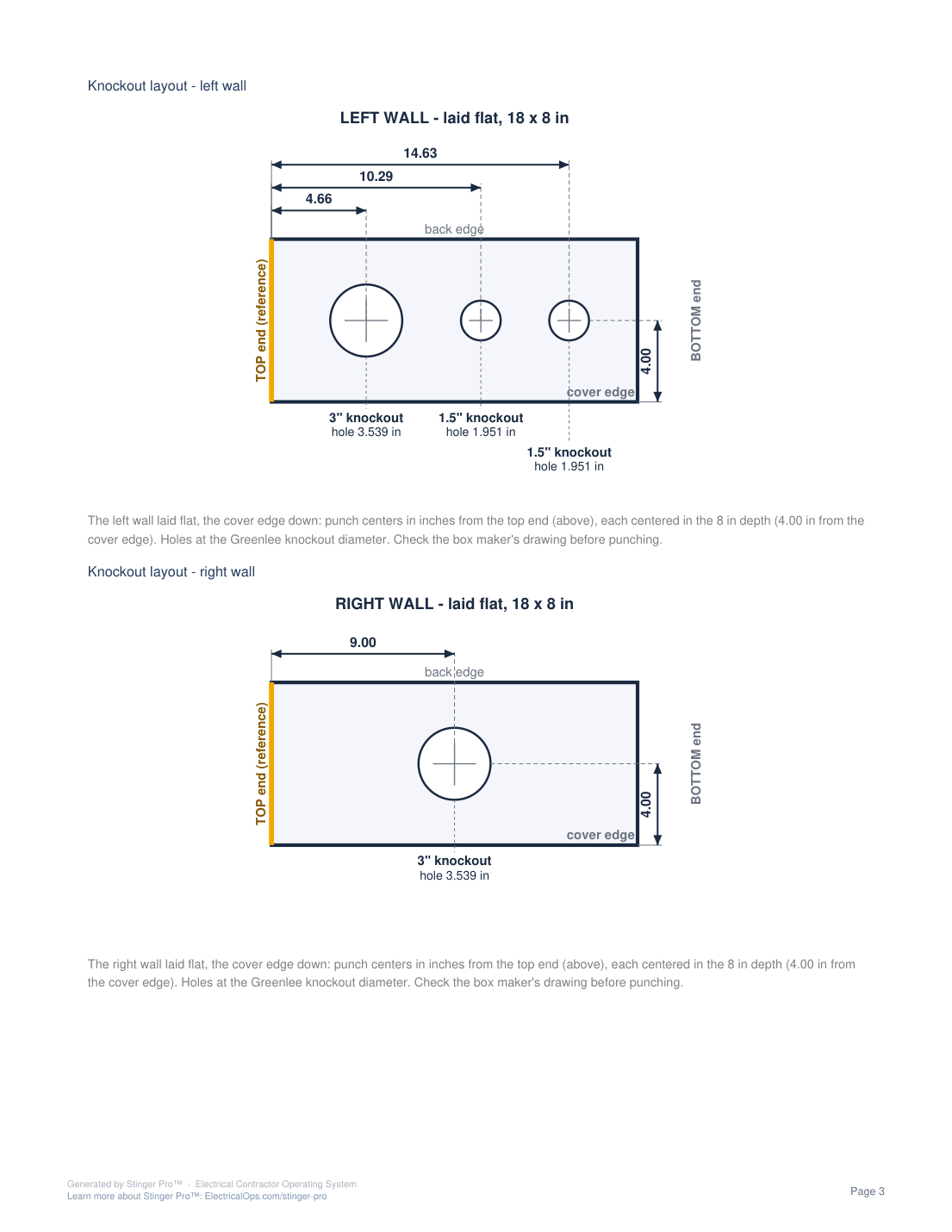
  5. Pull Box in Stinger Pro: The left wall laid flat with punch centers at 4.66, 10.29 and 14.63 in, and the right wall with its 3 in knockout at 9.00 in.
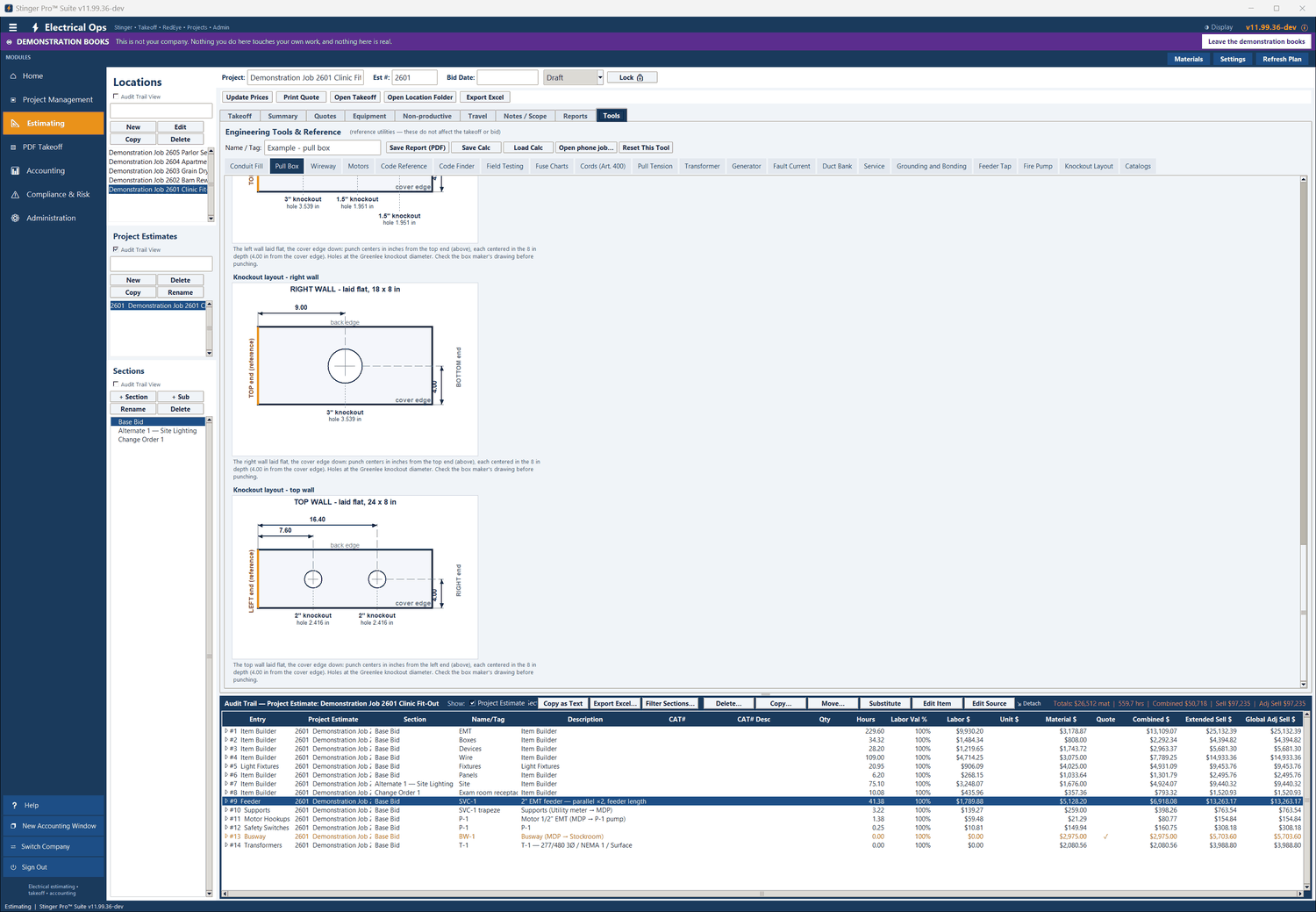
    STEP 5 OF 6The left wall laid flat with punch centers at 4.66, 10.29 and 14.63 in, and the right wall with its 3 in knockout at 9.00 in.

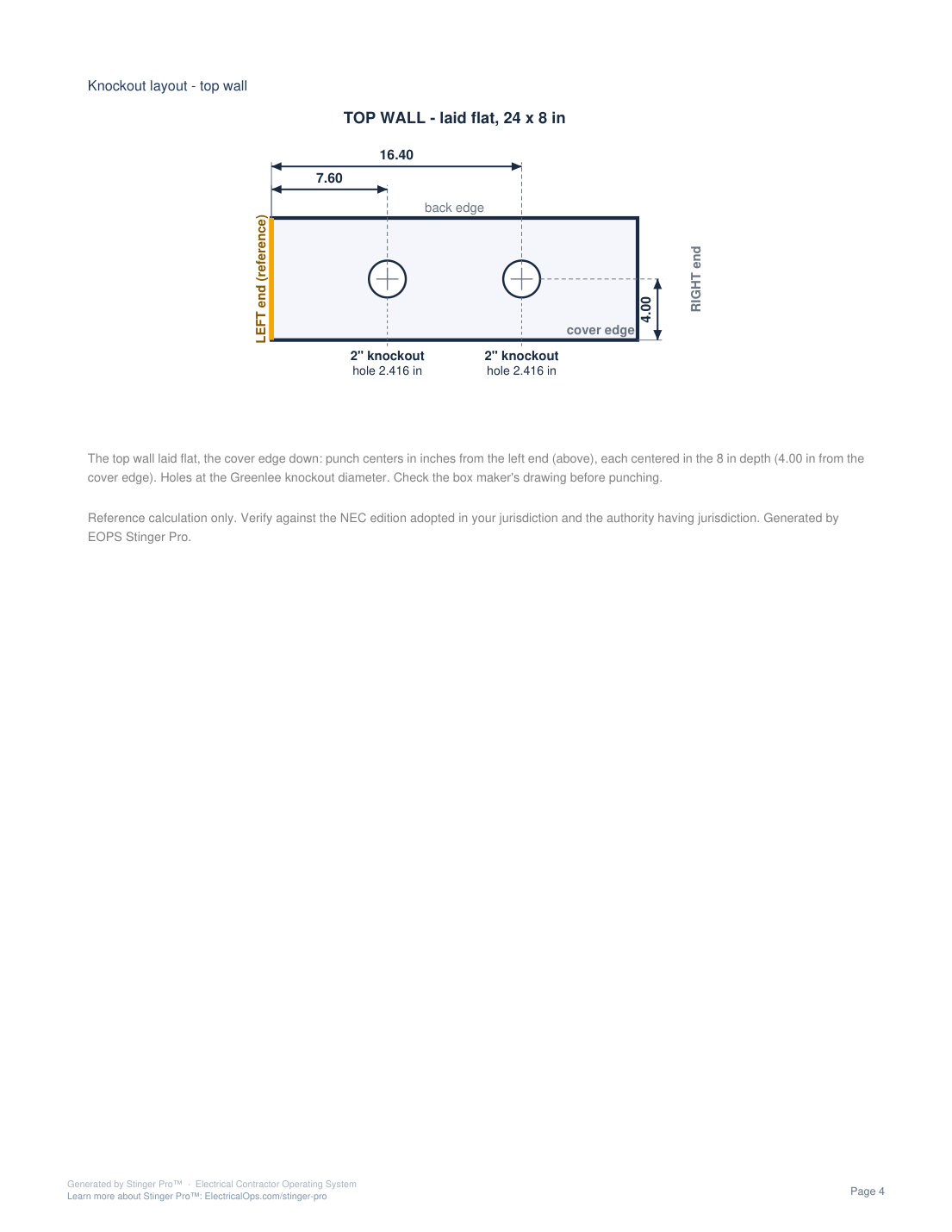
  6. Pull Box in Stinger Pro: The top wall laid flat: the two 2 in knockouts at 7.60 and 16.40 in from the left end, 4.00 in from the cover edge.

    STEP 6 OF 6The top wall laid flat: the two 2 in knockouts at 7.60 and 16.40 in from the left end, 4.00 in from the cover edge.

Opened from a takeoff entry, this tool sends its answer back into that entry: the three tools that do this.